
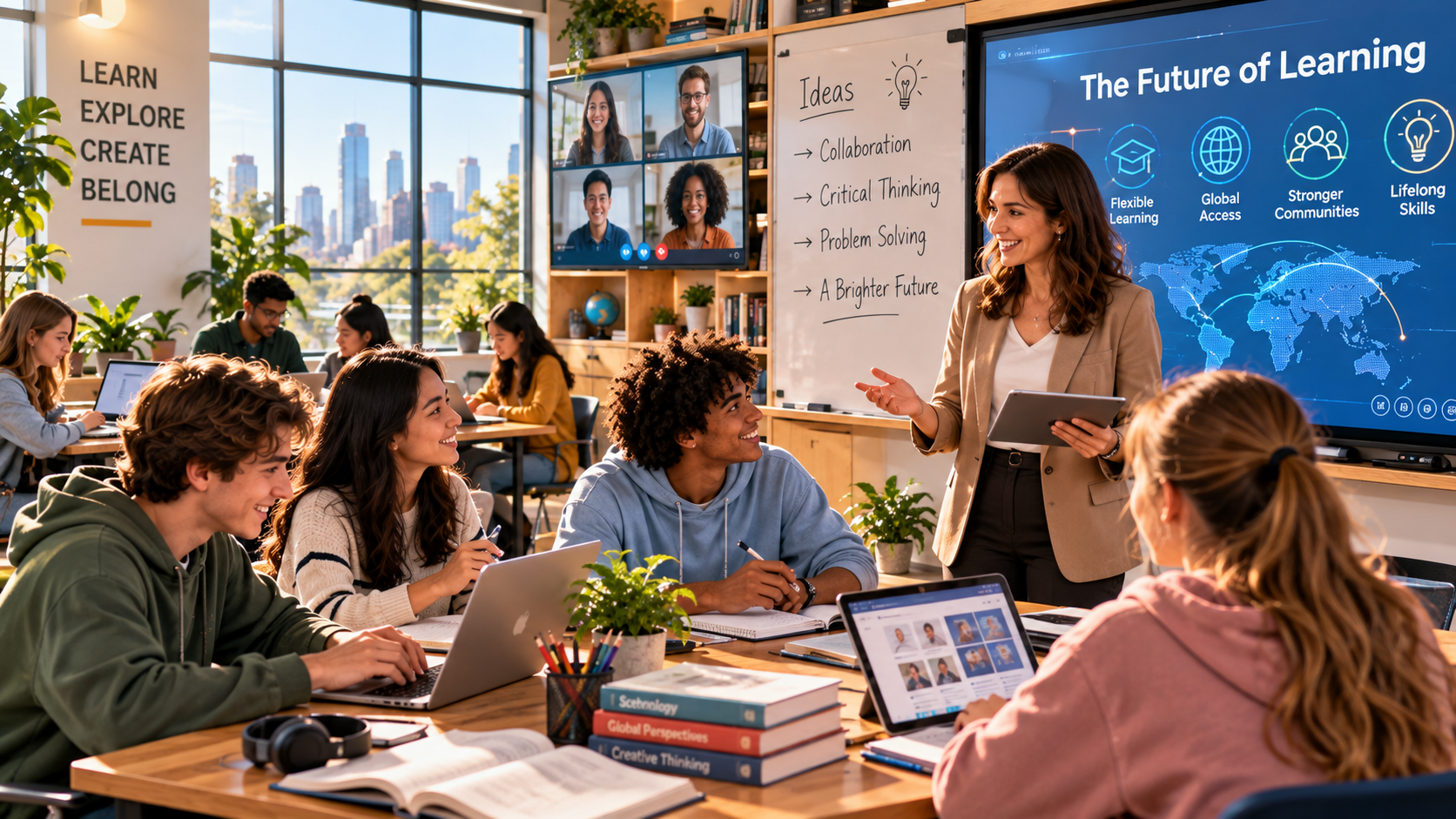
For generations, education followed a familiar pattern. Students entered classrooms at a particular age, followed a fixed curriculum, moved through a sequence of examinations and eventually left formal education to begin working. That model still shapes much of the world’s education systems, but the conditions surrounding it are changing rapidly.
People now live and work in an environment where knowledge becomes outdated faster, careers can change direction several times and digital tools have altered how information is accessed. At the same time, learners have very different circumstances, abilities and ambitions. A single educational pathway is becoming less capable of serving everyone equally well.
The result is not the disappearance of traditional education. It is a gradual shift toward a more flexible system in which learning can take place across different environments, at different speeds and at different stages of life.
The Classroom Is No Longer the Only Learning Environment
The physical classroom remains one of the most important places for education, particularly for younger learners. It provides structure, social interaction and direct contact with teachers. But it is increasingly part of a much larger learning environment.
Students can now access digital libraries, recorded lessons, interactive exercises, virtual laboratories and educational platforms outside school hours. This allows learning to continue beyond the traditional timetable and can give students additional opportunities to revisit difficult material.
UNICEF’s Digital Education Strategy 2025–2030 places particular emphasis on expanding equitable access to quality learning through technology while ensuring that digital education remains evidence-based and centred on learners and teachers. The strategy also focuses on children who are out of school or learning in disrupted circumstances.
The important change is therefore not simply that schools are becoming more digital. Education is becoming less dependent on a single physical location.
Flexibility Is Becoming a Core Educational Principle
Students do not learn in exactly the same way or at exactly the same pace. Some need more time to understand a concept, while others are ready to move ahead. Some learn effectively through discussion, others through practical activities, visual material or independent study.
Traditional systems have often struggled to accommodate these differences because large groups of students must move through the same curriculum according to the same timetable.
Digital tools can make differentiation easier. Educational platforms can provide additional exercises, adapt content to different levels and allow learners to return to material when necessary. But technology alone does not create personalised education. The quality of the learning design remains critical.
UNICEF’s research on flexible learning pathways argues that multiple routes into education can improve access for learners who do not fit conventional models, particularly those affected by disruption or other barriers to formal schooling.
This idea could become increasingly important as education systems attempt to serve more diverse populations.
Teachers Are Changing, Not Disappearing
Every major technological shift in education raises the same question: if technology can deliver information, what happens to the teacher?
The evidence points toward transformation rather than replacement.
Teachers remain responsible for explaining difficult ideas, recognising when a student is struggling, creating motivation and helping learners develop judgement. They also provide something that technology cannot easily reproduce: a human relationship built on trust, feedback and understanding.
The OECD’s 2025 research on digital education stresses that effective technology use requires teachers to adapt their pedagogical approaches rather than simply transferring traditional lessons onto digital platforms. Continued professional learning is therefore becoming increasingly important.
This changes the role of the teacher from being primarily a distributor of information to becoming a designer and guide of learning experiences.
Technology Works Best When It Solves a Real Problem
The arrival of new educational technology does not automatically improve education. A digital version of an ineffective lesson remains an ineffective lesson.
The more important question is what a technology allows teachers and students to do better.
A digital platform can make practice more accessible. An adaptive system can provide exercises at an appropriate level. A video can demonstrate a process that would be difficult to explain through text alone. Online collaboration can connect learners who would otherwise never work together.
The OECD’s research into digital transformation in school education highlights the need for education systems to consider not only infrastructure, but also pedagogy, curriculum, assessment, teacher capacity and the evaluation of digital tools.
This is why successful digital education is less about collecting devices and more about redesigning learning around clear educational goals.
The Digital Divide Has Not Disappeared
Greater access to technology can expand educational opportunities, but it can also expose existing inequalities.
Not every learner has the same access to reliable internet, suitable devices, quiet study environments or digital support. Even where technology is available, differences in digital skills and language accessibility can affect how effectively students benefit from it.
UNICEF’s current digital education strategy explicitly identifies digital divides related to gender, disability and language as barriers that need to be addressed. It also emphasises the importance of reaching children both inside and outside formal education systems.
This means the future of education cannot simply be about making learning digital. It has to be about making digital learning genuinely accessible.
Learning Can Become More Personal
One of the most significant changes in modern education is the possibility of giving students greater control over their learning.
Personalisation does not mean every student receives an entirely different curriculum. It can mean having more choice over pace, resources, practice and the ways in which knowledge is demonstrated.
A learner who has difficulty with mathematics may benefit from additional guided exercises. Another student may be ready for more advanced material. Someone studying outside a traditional school environment may need a completely different schedule.
These differences are easier to accommodate when educational systems are designed around flexible pathways rather than rigid sequences.
The OECD’s Education Policy Outlook 2025 places learner agency at the centre of lifelong learning, arguing that people increasingly need the ability to identify, acquire and apply new knowledge and skills across different contexts.
Assessment Is Also Being Reconsidered
If learning becomes more flexible, assessment has to evolve with it.
Traditional examinations remain useful because they provide common standards and can measure specific knowledge. But they do not always capture creativity, collaboration, problem-solving, communication or the ability to apply knowledge in unfamiliar situations.
Modern education is therefore placing greater emphasis on formative assessment, projects, practical tasks and continuous feedback.
Technology can support this process by helping teachers identify patterns in student performance and providing faster feedback. Yet interpretation still matters. A system can show that a student repeatedly answers a question incorrectly, but a teacher may be better positioned to understand why.
Assessment is gradually moving from being primarily a final judgement toward becoming part of the learning process itself.
The Skills Students Need Are Broader
The future workplace will not require students simply to remember more information. It will require them to know how to work with information.
Critical thinking, communication, collaboration, digital literacy and adaptability are becoming increasingly important alongside traditional academic knowledge.
This does not make subject knowledge less valuable. In fact, meaningful critical thinking usually depends on having enough knowledge to understand a problem in the first place. The challenge is to combine strong foundations with the ability to apply them.
UNICEF’s digital education strategy similarly emphasises not only digital literacy but also socioemotional skills, green skills and AI-related competencies as part of preparing learners for a changing world.
Education is therefore moving toward a broader definition of competence.
Learning Is Becoming Less Tied to Age
Perhaps the biggest long-term change is that education is increasingly extending beyond childhood and early adulthood.
People are living longer and working through more complicated career paths. A qualification earned at the beginning of a career may no longer provide all the knowledge needed decades later. Workers may need to learn new technologies, change professional direction or acquire entirely new skills.
The OECD’s Education Policy Outlook 2025 identifies lifelong learning as essential in a world shaped by digitalisation, demographic change and longer lives. It also highlights several important points in life when people may need additional support to remain engaged in learning.
This changes the traditional relationship between education and age. Learning is increasingly becoming something people return to rather than something they complete once.
The Human Element Remains Central
The future of education will certainly involve more technology, but the most important transformation may be cultural rather than technical.
Schools and universities are beginning to recognise that successful learning depends on motivation, relationships, confidence and a sense of purpose. A sophisticated platform cannot compensate for a student who feels disconnected from the learning process, just as an impressive digital classroom cannot replace a skilled teacher.
The OECD’s Teaching Compass argues for a stronger role for teachers as adaptive experts and active participants in shaping educational change. It emphasises teacher agency, professional competence and well-being as important conditions for meaningful transformation.
That perspective points toward a future in which technology supports education without defining it.
A More Flexible Model of Learning
The education system of the future may look less like a single road and more like a network of connected pathways.
Students may move between classrooms, digital platforms, practical experiences and independent study. Adults may return to formal education several times during their careers. Teachers may combine face-to-face instruction with digital resources and personalised support. Institutions may increasingly measure not only whether someone completed a course but also what they can actually do with what they learned.
This does not mean traditional education is becoming obsolete. Schools, teachers, universities and physical learning environments will remain essential. What is changing is the expectation that education should adapt more effectively to the people it serves.
The future of learning will therefore not be defined by technology alone. Its real measure will be whether education becomes more accessible, more responsive and more capable of helping people continue learning as their lives change.
In a world where knowledge, careers and technologies are constantly evolving, the most valuable education may no longer be the one that prepares a person for a single destination. It may be the one that gives them the confidence, skills and curiosity to keep learning wherever the road leads.