
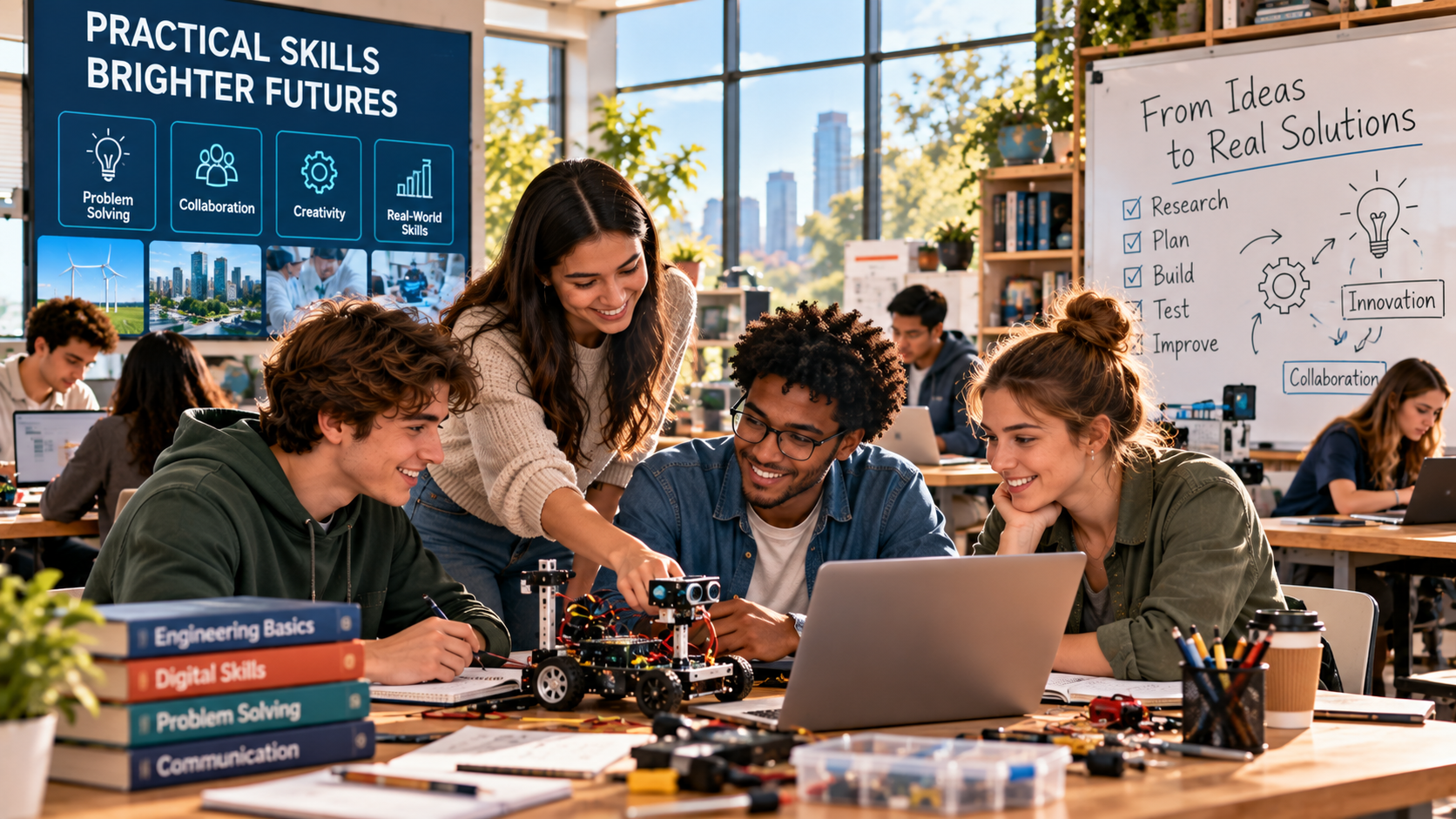
For much of modern history, education was built around a simple idea: learn first, work later. Students spent years acquiring academic knowledge before entering professional life, with schools and universities serving as the main gateways to employment.
That model is becoming harder to maintain.
The modern economy changes too quickly for education to stop at memorising established knowledge. New technologies alter workplaces, entire industries evolve, and employers increasingly need people who can apply information rather than simply recall it. At the same time, students are expected to navigate a world that requires communication, collaboration, digital competence and independent decision-making.
This does not make traditional academic knowledge less important. It changes how that knowledge needs to be used.
The strongest education systems are increasingly looking beyond the classroom to connect learning with practical situations. The result is a broader understanding of what it means to be prepared for adult life.
Knowledge Becomes More Valuable When It Can Be Applied
Academic knowledge provides the foundation for learning, but information becomes significantly more useful when students understand how it works outside a textbook.
A physics concept can become clearer when students use it to understand an engineering problem. Economics becomes more tangible when learners examine how businesses make decisions. Writing skills become more meaningful when students use them to communicate an argument, create a professional document or explain a complicated idea to a real audience.
Practical education does not replace theory. It gives theory a context.
This distinction is becoming increasingly important because modern workplaces rarely divide tasks according to school subjects. A professional may need technical knowledge, communication skills, problem-solving ability and digital competence at the same time.
Education therefore has to help students connect different types of knowledge rather than treating each subject as an isolated area.
Employers Are Looking for More Than Qualifications
A diploma or degree remains an important signal of education and expertise, but qualifications alone do not always reveal how effectively someone can use what they know.
Employers increasingly value people who can analyse unfamiliar situations, communicate clearly, collaborate with colleagues and adapt when circumstances change. These abilities are difficult to demonstrate through traditional examinations alone.
The OECD has repeatedly highlighted the growing importance of skills that allow people to adapt to technological and economic change. Its Skills Outlook work emphasises the need for people to develop skills that support participation in rapidly changing societies and labour markets.
This is not an argument against academic qualifications. Rather, it suggests that education needs to make the connection between qualifications and real capabilities more visible.
A student should ideally leave education not only knowing a subject, but also knowing what to do with that knowledge.
Project-Based Learning Brings Reality Into the Classroom
One way schools and universities are addressing this challenge is through project-based learning.
Instead of receiving information and reproducing it in an examination, students can be asked to solve a problem, develop a proposal, conduct research, create a product or work with others toward a defined outcome.
The difference is significant. Projects introduce uncertainty, because there is not always one correct answer. Students have to decide what information matters, divide responsibilities, evaluate alternatives and respond when an initial approach fails.
Those are precisely the kinds of situations people encounter outside education.
Project-based learning can also reveal strengths that conventional assessment sometimes misses. A student who performs moderately in a written examination may demonstrate exceptional organisational, creative or communication skills when working on a complex project.
Communication Has Become a Core Skill
Technical knowledge is valuable, but the ability to explain that knowledge has become equally important.
A software developer needs to communicate with colleagues. A scientist may need to explain research to policymakers or the public. An engineer has to present technical decisions. A business professional needs to write clearly, negotiate and persuade.
Communication is therefore no longer simply an additional skill taught through language classes. It is part of almost every profession.
Students can develop it through presentations, debates, collaborative projects, writing assignments and practical simulations. These activities force learners to think about not only what they know but also how another person will understand it.
That is a fundamentally different educational experience from memorising information for an examination.
Digital Literacy Is Becoming a Basic Competence
The growing role of technology has expanded the meaning of practical education.
Digital literacy is not simply knowing how to operate a computer or smartphone. It involves understanding how digital systems work, evaluating information, protecting personal data and using technology responsibly.
The OECD’s work on digital education stresses that learners need more than access to digital tools. They need the skills to use those tools effectively and critically, while education systems need to prepare teachers and institutions for the broader transformation created by digital technologies.
This becomes particularly important as artificial intelligence and automated systems become increasingly common.
Students will need to understand when technology is useful, when its output should be questioned and how to combine automated tools with human judgement. Practical digital education therefore means developing confidence without encouraging blind trust.
Problem-Solving Cannot Be Memorised
One of the limitations of traditional education is that problems presented in textbooks are often carefully structured. Real problems rarely are.
Outside the classroom, information may be incomplete, priorities may conflict and the most obvious solution may not work. People have to identify the problem before they can solve it.
Education can prepare students for this reality by giving them situations where they have to investigate, test ideas and revise their approach.
The process matters as much as the final answer. Students learn that failure can provide useful information, that assumptions need to be questioned and that complicated problems often require several attempts.
These lessons are difficult to acquire through memorisation alone.
Collaboration Changes the Learning Experience
Modern workplaces are rarely built around people working entirely alone. Teams bring together different forms of expertise, personalities and perspectives.
Education can prepare students for this environment by making collaboration a meaningful part of learning rather than simply placing students into groups and assigning them a common task.
Effective collaboration requires responsibility. Students need to communicate, negotiate roles, resolve disagreements and make decisions about how to complete a project.
These experiences can also teach an important lesson: expertise is often distributed across a group. One person may have the strongest technical knowledge, another may communicate best and another may see a problem that everyone else overlooked.
Learning how to combine those strengths is a practical skill in itself.
Financial and Everyday Skills Matter Too
Practical education should not be limited to preparation for professional employment.
Students also need to understand the systems they will encounter as adults. Financial decisions, contracts, personal budgets, digital security, communication with institutions and basic consumer rights can have a major influence on everyday life.
Yet these subjects have traditionally received less attention than conventional academic disciplines.
The growing emphasis on financial literacy illustrates the change. The OECD’s Programme for International Student Assessment has increasingly examined whether young people have the knowledge and skills needed to make effective financial decisions in real life. Its financial literacy framework includes understanding money, planning, managing resources and evaluating financial choices.
Education becomes more useful when students can recognise the connection between what they learn and the decisions they will soon have to make independently.
Work Experience Can Bridge Two Different Worlds
One of the clearest ways to connect education with practical life is to give students opportunities to experience professional environments.
Internships, apprenticeships, workplace projects and career-oriented programmes allow learners to see how knowledge is applied under real conditions. They can also help students discover what they actually enjoy before committing to a particular career path.
Work experience can reveal something that classroom learning cannot always show: the difference between understanding a profession in theory and experiencing its daily reality.
For employers, these programmes can also create an opportunity to identify emerging talent and communicate the skills that industries actually need.
The strongest partnerships between education and employers are not simply recruitment pipelines. They can help educational institutions understand how professional requirements are changing.
Teachers Have to Become Connectors
Practical education also changes the role of teachers.
A teacher does not need to become an industry professional to make learning relevant. But teachers increasingly need opportunities to understand how their subject connects to the wider world.
That might mean bringing real examples into lessons, inviting professionals to speak with students, organising practical assignments or connecting academic concepts to current problems.
The teacher remains the person who provides structure and intellectual guidance. The difference is that the classroom becomes a place where students learn to transfer knowledge rather than simply store it.
This requires professional development as well. Teachers need time, resources and institutional support if schools expect them to develop more applied forms of learning.
Practical Education Should Not Become Narrow Job Training
There is a danger in pushing practical education too far in one direction.
If schools focus entirely on the immediate needs of employers, education can become too narrow. Students may learn how to perform today’s tasks without developing the broader intellectual abilities needed to adapt when those tasks change.
The purpose of practical education should therefore be wider than vocational preparation.
Critical thinking, creativity, history, mathematics, science, literature and social sciences all contribute to practical capability because they help people understand complex situations. The most useful education combines deep knowledge with the ability to apply it.
Preparing someone for the future means teaching them both how systems work and how to respond when those systems change.
The Classroom Is Becoming a Place to Practise Life
The most interesting change in education may be the gradual disappearance of the boundary between learning and doing.
Students are increasingly expected to research real problems, build projects, collaborate with others, communicate their ideas and make decisions based on evidence. These activities bring the logic of adult life into education without removing the protected environment of the classroom.
That balance is important. Students need opportunities to experiment and make mistakes before those mistakes carry serious professional consequences.
Education can provide exactly that environment.
The future classroom may therefore look less like a place where students prepare for life and more like a place where they begin practising it. Academic knowledge will remain essential, but its value will increasingly be measured by what learners can understand, create, explain and solve with it.
In a rapidly changing world, the most successful education may not be the one that gives students every answer. It may be the one that teaches them how to approach problems they have never encountered before.