
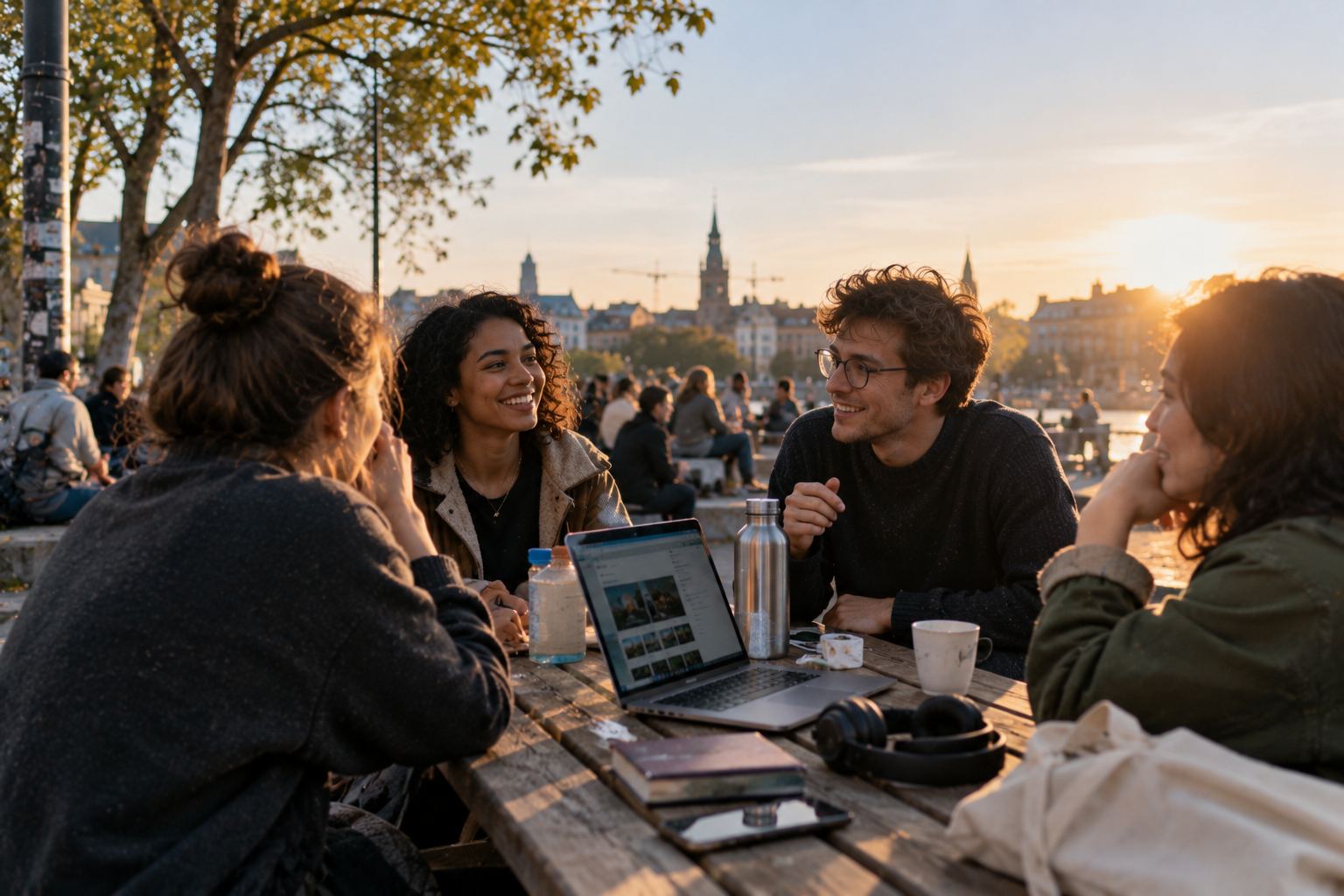
For much of human history, belonging was largely determined by circumstance. People were born into families, neighbourhoods, religious communities and local networks that shaped their identity and responsibilities. Social life was closely tied to geography, and most relationships developed within relatively stable communities.
Modern life has loosened many of those boundaries.
People move more frequently, change careers, live farther from relatives and spend more of their social lives online. Cities bring together people from different backgrounds, while digital platforms allow friendships and communities to form without physical proximity. Individual choice has expanded, but so has the possibility of isolation.
The result is a paradox at the heart of contemporary society: people have more opportunities than ever to choose who they spend time with, yet maintaining meaningful connections can sometimes be surprisingly difficult.
This does not mean communities are disappearing. Instead, the meaning of community is changing. Belonging is becoming less dependent on where people live and more dependent on shared interests, experiences, values, activities and forms of mutual support.
From Place-Based Communities to Networks of Choice
The traditional neighbourhood provided a ready-made social environment. People encountered the same neighbours repeatedly, children attended nearby schools, local businesses became familiar meeting points and community events created opportunities for interaction.
Modern mobility has made these relationships less predictable.
People may work in one part of a city, live in another and maintain their closest friendships somewhere else. Families can be spread across several regions, while professional and social networks may extend across national borders.
Digital communication has accelerated the transition from communities based primarily on place to communities based increasingly on networks.
A person interested in a particular sport, profession, hobby or cultural subject can now find others who share that interest regardless of where they live. These connections can become highly meaningful even when participants rarely meet face to face.
Geography still matters, but it is no longer the only foundation of social belonging.
Individual Freedom Has Changed the Meaning of Belonging
Greater personal freedom is one of the defining features of modern society. People have more opportunities to choose their careers, lifestyles, relationships and social circles than many previous generations did.
That freedom can be empowering, but it also transfers more responsibility to individuals.
In a traditional community, social participation often happened automatically. In a more individualistic society, people may have to actively search for relationships and decide which communities they want to join.
This creates a different social skill set. People need to maintain connections across different environments, manage relationships digitally and physically, and sometimes build new networks after moving to a new city or changing jobs.
The ability to choose one’s communities can therefore create both freedom and uncertainty.
A person is less likely to be completely defined by a single community, but they may also have to work harder to create a stable sense of belonging.
The Rise of Smaller and More Flexible Communities
Not every modern community needs thousands of members.
Some of the strongest social networks are relatively small: a group of neighbours, a volunteer organization, a sports club, a professional association or a group of people who meet regularly around a shared interest.
Their strength often comes from repeated interaction.
People build trust when they see one another regularly, cooperate on practical tasks and discover that others can be relied upon. These relationships can be particularly important in cities, where large populations can coexist with surprisingly little interaction between strangers.
This helps explain why community spaces remain important even in highly connected societies.
Libraries, parks, cultural centres, sports facilities, cafés and local meeting places provide physical settings where people can encounter one another without requiring a close personal relationship in advance.
The value of these spaces is not only recreational. They create opportunities for social contact that cannot be completely replaced by private digital communication.
Digital Communities Are Becoming Part of Ordinary Social Life
The idea that online relationships are somehow less real than physical relationships is increasingly difficult to maintain.
For many people, digital communities are now part of everyday social life. People maintain friendships through messaging platforms, participate in professional networks, exchange advice in online groups and build long-term communities around shared interests.
For individuals whose interests or circumstances make local connections difficult, digital communities can be particularly valuable.
They can also help people maintain relationships during periods of geographical separation. Family members living in different places can remain involved in one another’s lives through frequent communication, while friends can continue shared activities without being physically together.
At the same time, online communities have their own weaknesses.
Digital spaces can become fragmented, highly polarized or dominated by people with similar views. Algorithms may repeatedly expose users to familiar opinions, reducing opportunities for constructive disagreement.
The challenge is therefore not to choose between online and offline community. Increasingly, strong social networks combine both.
Loneliness Reveals the Limits of Connection
The expansion of communication technology has not eliminated loneliness.
The World Health Organization has identified social connection as an important public health and social issue, noting that loneliness and social isolation affect people across different ages and circumstances. In 2025, the WHO Commission on Social Connection reported that approximately one in six people worldwide experiences loneliness.
Loneliness is not simply the absence of people. Someone can have hundreds of online contacts and still feel that they lack relationships in which they can rely on others or speak openly.
This distinction matters because it shifts attention away from the quantity of communication toward its quality.
A busy social calendar does not necessarily produce belonging. What matters is whether people experience relationships that provide recognition, trust and a sense that they are part of something larger than themselves.
Community policy therefore cannot be reduced to creating more opportunities for people to meet. The deeper task is creating environments in which meaningful relationships have room to develop.
Workplaces Are Becoming Social Environments Too
Changes in employment are also influencing community life.
For many adults, the workplace has historically been one of the most important places for everyday social interaction. Colleagues shared routines, solved problems together and developed relationships through repeated contact.
The growth of remote and hybrid work has changed that pattern.
Flexible employment can improve autonomy and make it easier for people to balance professional and personal responsibilities. But reduced physical contact can also remove informal social interactions that were once taken for granted.
A conversation before a meeting, lunch with colleagues or an unexpected discussion in a shared workspace may appear insignificant, yet these moments contribute to familiarity and trust.
As organizations become more flexible, they therefore face a social question as well as a technological one: how can workers maintain meaningful professional relationships when physical proximity is no longer guaranteed?
The answer may involve a combination of occasional face-to-face interaction, thoughtful workplace design and stronger recognition of the social role that employment can play.
Migration Is Creating More Layered Communities
Migration has also changed the structure of community life.
People increasingly maintain connections across multiple places. A migrant may participate in the society where they live while maintaining strong family, cultural and economic relationships with people elsewhere.
This can create communities that are simultaneously local and global.
Cultural traditions can travel through families and digital networks. Languages can remain active across borders. People can support relatives financially while participating fully in a different local economy.
These overlapping identities challenge the idea that belonging must be tied to a single place.
They can also enrich the communities where people settle by introducing different languages, traditions, foods, skills and perspectives. At the same time, successful integration requires opportunities for interaction rather than simply physical coexistence.
A diverse society becomes more cohesive when people have spaces in which different groups can actually encounter one another.
Community Participation Can Strengthen Social Resilience
Strong communities are not defined only by friendship. They also provide practical support during difficult periods.
Neighbourhood networks can help people respond to emergencies, share information and identify individuals who need assistance. Volunteer organizations can mobilize resources quickly, while local knowledge can help institutions understand problems that may not be visible from a distance.
This becomes particularly important during periods of economic disruption, extreme weather or other forms of crisis.
Social connections can make it easier for people to coordinate action because trust already exists before the crisis begins.
That is one reason investment in community life should not be treated as a purely cultural or recreational concern. Social networks can function as a form of resilience.
A community in which people know one another is often better positioned to respond collectively when circumstances change.
Cities Have to Design for Social Interaction
Urbanization has made the physical design of communities increasingly important.
A city can provide excellent infrastructure while still making social interaction difficult. Long distances, limited public spaces, unsafe pedestrian routes and an absence of shared facilities can encourage people to move between private spaces without developing local connections.
Urban planners are increasingly paying greater attention to the relationship between physical environments and social life.
Walkable streets, parks, libraries, community centres, public squares and mixed-use neighbourhoods can create opportunities for people to interact naturally. These spaces do not guarantee community, but they make community more possible.
The principle is relatively simple: people need places where they can be together without having to purchase something or make a formal appointment.
Public space can therefore be understood as social infrastructure.
The Future of Community Will Be Both Local and Global
The most important change in modern community life may be that people no longer have to choose between local belonging and wider networks.
A person can know their neighbours, participate in a local organization and simultaneously maintain friendships with people on another continent. A professional community can operate globally while a volunteer group remains deeply local.
These different layers of belonging can coexist.
The challenge is ensuring that digital connectivity and individual freedom do not come at the expense of meaningful relationships. Technology can help people find communities, but it cannot guarantee trust. Mobility can expand opportunities, but it can also disrupt established networks. Individual choice can increase freedom, but it can also leave people responsible for building connections that previous generations inherited automatically.
Modern society therefore needs to rethink what community means.
It is no longer simply the group of people who happen to live nearby. It is a network of relationships in which people recognize one another, exchange support and participate in something shared.
The strongest communities of the future will probably combine the advantages of both worlds: the accessibility of digital networks and the trust created through real-world interaction.
In a society where people can live, work and communicate across enormous distances, belonging has become more flexible than ever. But the underlying need has not changed. People still need places, relationships and communities in which they feel that they matter.