
For centuries, preserving cultural heritage meant protecting physical objects and places from time, weather, conflict and human activity. Conservators repaired damaged structures, museums controlled temperature and humidity, and archives stored documents in carefully managed conditions.
Those methods remain essential. But the preservation landscape is changing.
Digital technologies now allow specialists to record historic buildings in extraordinary detail, reconstruct damaged objects, monitor fragile sites and make collections accessible to people who may never visit them in person. Three-dimensional scanning, satellite imagery, photogrammetry, digital archives and virtual environments are creating new possibilities for understanding the past.
The technology does not make heritage indestructible. A digital model cannot stop a building from deteriorating, and a virtual reconstruction cannot replace the cultural meaning of an original place. What technology can do is create another layer of protection, documentation and access.
From Photographs to Digital Twins
Photography transformed heritage documentation by allowing specialists to record monuments and objects without physically moving them. Digital imaging has taken that process much further.
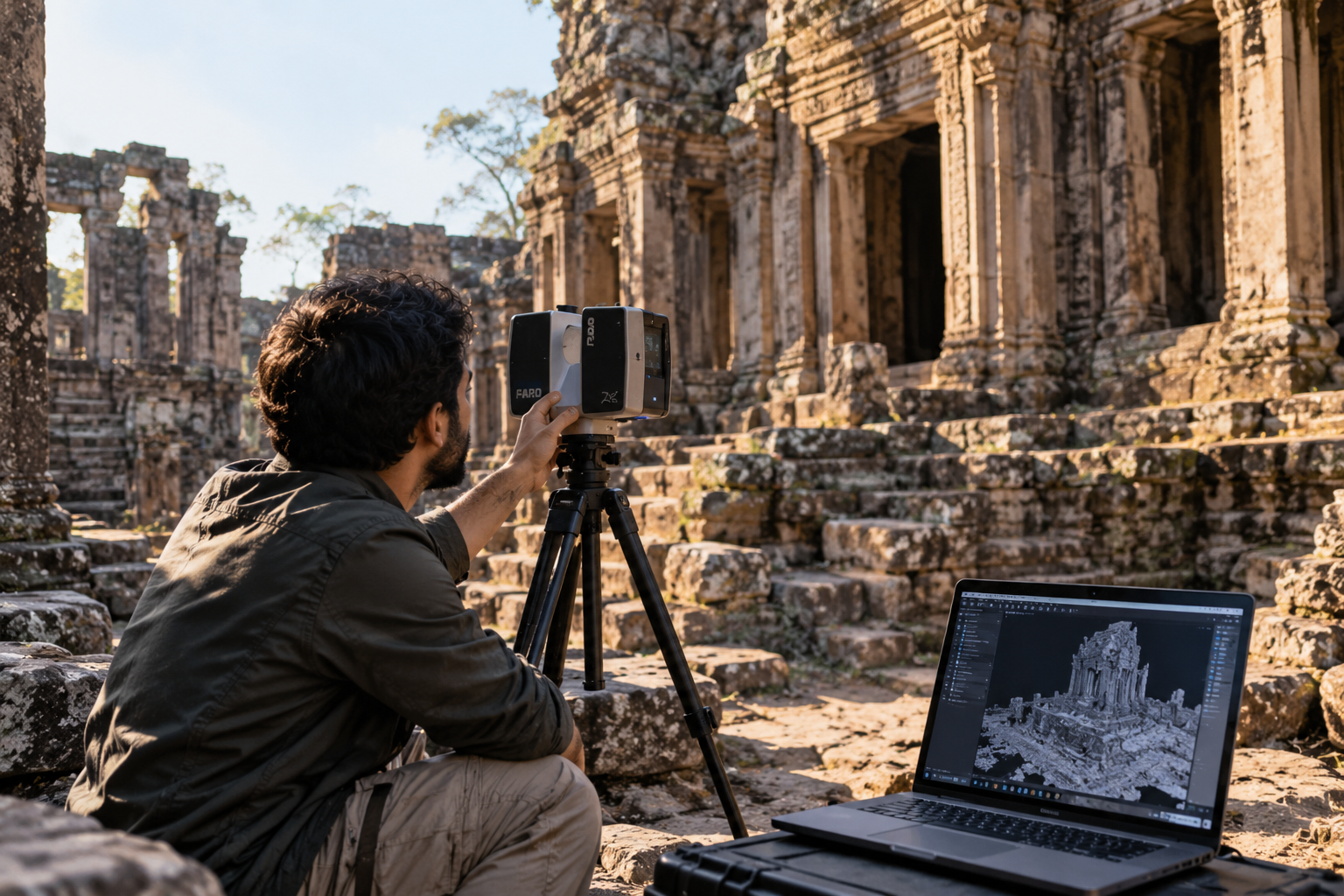
Modern scanning systems can capture the geometry of buildings, sculptures and archaeological sites with remarkable precision. Photogrammetry can combine hundreds or thousands of photographs to create detailed three-dimensional models. These models can then be measured, analysed and stored digitally.
The result can be described as a form of digital twin: a detailed digital representation of a physical object or site.
For conservation specialists, this can be extremely valuable. A digital record created today provides a reference against which future changes can be measured. If a crack appears in a historic structure, for example, specialists can compare new scans with previous records to determine how the damage has developed.
The value lies not only in the image itself, but in the information contained within it.
Digital Documentation Can Preserve Evidence Before It Disappears
Heritage sites are not permanent.
Buildings deteriorate, archaeological objects are damaged, landscapes change and some sites face environmental or human threats. In situations where complete physical preservation is impossible, detailed documentation can at least preserve knowledge about what existed.
UNESCO has increasingly supported digital technologies as tools for documenting, preserving and communicating cultural heritage. Its work on digital transformation in the cultural sector recognises the potential of technologies such as artificial intelligence, virtual reality and three-dimensional modelling while also stressing the need for responsible use and long-term preservation of digital data.
This distinction is important.
Digital documentation is not the same as conservation. A scan can record a building, but it cannot preserve the original material, craftsmanship or historical atmosphere. Nevertheless, when physical heritage is threatened, detailed digital documentation can become an invaluable record.
Archaeology Is Becoming More Data-Driven
Technology is also changing the way archaeologists discover and investigate sites.
Satellite imagery can reveal changes in landscapes that are difficult to see from the ground. Remote sensing technologies can identify patterns beneath vegetation or soil. Geographic information systems can combine archaeological evidence with topographic, environmental and historical data.
These methods allow researchers to investigate much larger areas without excavating every location.
The benefit is significant because excavation itself can be destructive. Once soil layers are removed, they cannot simply be restored to their original condition. Remote sensing can help researchers decide where excavation is most likely to produce useful information before disturbing the site.
Technology is therefore not simply making archaeology faster. It can also make the discipline more selective.
Three-Dimensional Models Change the Way Objects Can Be Studied
A digital three-dimensional model can be manipulated in ways that a physical object cannot.
Researchers can rotate an object, examine details from different angles, measure dimensions and compare it with other objects without handling the original. Students can explore digital replicas without travelling to a museum or archaeological site.
For fragile objects, this can reduce the need for repeated physical handling.
The technology is particularly useful when an object is too delicate, too large or too geographically distant to be studied directly by every researcher who needs access to it.
Digital models can also make collaboration easier. Specialists in different institutions can work from the same dataset, compare observations and develop new interpretations without requiring the original object to be transported.
Virtual Reality Brings Heritage Into New Environments
Virtual reality has introduced another possibility: allowing people to experience places they cannot physically visit.
A digitally reconstructed archaeological site can be explored from a computer or immersive headset. Visitors can move through a historical environment, examine architectural details and experience spatial relationships that are difficult to communicate through photographs.
This can be particularly valuable for education.
A student reading about an ancient settlement may understand its history more clearly after exploring a three-dimensional reconstruction. A museum visitor may gain a better sense of how an incomplete building originally functioned when digital layers show structures that no longer survive.
But virtual experiences also create a responsibility.
A reconstruction can appear extremely convincing even when parts of it are based on interpretation rather than direct evidence. Digital heritage projects therefore need to distinguish clearly between what is known, what has been reconstructed and what remains uncertain.
Museums Are Becoming Digital Cultural Spaces
The traditional museum experience is built around physical collections. Digital technology is expanding that model.
Museums can now create online exhibitions, searchable databases, interactive collections and high-resolution digital archives. Visitors can examine objects from different angles, zoom into details that are difficult to see behind glass and explore collections that may not be displayed permanently.
This can also change how museums reach audiences.
A person living far from a major cultural institution can access digitised collections without travelling. Researchers can search collections across institutions. Teachers can use museum material in classrooms that are thousands of kilometres away.
UNESCO’s work on digital transformation in culture highlights the potential of digital technologies to expand access to cultural resources while also drawing attention to issues such as digital inequality, data governance and the long-term preservation of digital material.
Digital access can therefore complement physical museums rather than replace them.
Artificial Intelligence Is Entering Heritage Research
Artificial intelligence is creating another layer of possibilities.
Machine-learning systems can help researchers analyse large collections, recognise patterns in images, organise archives and assist with the transcription or translation of historical documents. In large collections, automation can help specialists locate relevant material much faster than manual searching alone.
AI can also support the reconstruction of damaged or incomplete cultural objects, although these applications require careful human oversight.
The central problem is that AI systems can generate plausible results that are not historically accurate. A reconstruction may look convincing while quietly introducing details for which there is no evidence.
For heritage work, therefore, accuracy matters more than visual realism.
AI can assist researchers, but interpretation still needs to remain transparent. Users should be able to understand whether a digital reconstruction is based on documented evidence, comparative analysis or an algorithmic approximation.
Monitoring Heritage Is Becoming More Continuous
Technology is also changing the way conservation specialists monitor physical sites.
Sensors can measure humidity, temperature, vibration and structural movement. Cameras can document changes over time. Satellite systems can monitor landscapes and detect environmental changes across large areas.
This allows conservation to become more preventive.
Instead of waiting until visible damage becomes severe, specialists can monitor conditions that may indicate a developing problem. Changes in humidity can affect fragile materials. Repeated vibration can threaten structures. Water infiltration can create long-term damage before it becomes obvious to visitors.
Continuous monitoring does not eliminate deterioration, but it can give conservation teams more time to respond.
Climate Change Makes Digital Documentation More Important
Environmental change is creating additional pressure on cultural heritage.
Flooding, storms, rising temperatures, coastal erosion and changing humidity can damage buildings, archaeological sites and cultural landscapes. Some heritage sites are located in environments where adaptation is becoming increasingly difficult.
ICOMOS identifies climate change as one of the major threats facing cultural heritage and has increasingly focused on both protecting heritage from climate impacts and using heritage knowledge as part of climate adaptation.
Digital documentation can be particularly valuable in this context because environmental conditions can change faster than conservation programmes can respond.
Creating detailed records does not solve the underlying problem. But it can preserve evidence, support monitoring and provide specialists with a baseline for future conservation decisions.
Digital Heritage Has Its Own Preservation Problem
There is an irony at the heart of digital heritage.
Technology is being used to preserve the past, but digital information itself can become obsolete.
File formats disappear. Storage systems fail. Software changes. Hardware becomes incompatible. A digital archive created today may not be easily accessible several decades from now unless institutions actively maintain it.
Digital preservation therefore requires more than saving files.
Institutions need reliable storage, metadata, backup systems, documentation and strategies for migrating information into new formats as technology changes.
In other words, digitisation creates a new preservation responsibility.
A heritage institution may successfully protect a physical object for centuries but lose a valuable digital record within a few decades if its digital infrastructure is neglected.
Access Must Be Balanced With Protection
Digital technology can make heritage more accessible, but access also raises questions about ownership and control.
Who owns a digital scan of a cultural object? Who can use it commercially? Should every archaeological site be publicly mapped in detail? How should communities participate in decisions about digitising culturally sensitive material?
These questions are becoming increasingly important as digital heritage expands.
UNESCO has stressed the need for ethical approaches to digital transformation in culture, including questions of access, diversity, rights and the preservation of cultural identity.
Technology can democratise access, but it can also reproduce existing inequalities if digital resources remain controlled by a small number of institutions or if communities whose heritage is being documented have little influence over how the material is used.
The Original Still Matters
The rapid growth of digital heritage should not create the impression that physical heritage is becoming unnecessary.
A digital reconstruction of a historic building does not have the same material presence as the original. It cannot reproduce the texture of stone, the marks left by craftsmen, the relationship between a structure and its landscape or the accumulated memories associated with a place.
Digital heritage is therefore best understood as a complement.
It can document what exists, make research easier, expand access and provide educational experiences. It can also preserve information when physical heritage is threatened. But the original object or place remains the source from which that digital representation derives its meaning.
The goal is not to replace heritage with technology. It is to use technology to understand and protect heritage more effectively.
A New Era of Preservation
The most important development in digital heritage may be the shift from static documentation to continuous knowledge.
A historic building can now be scanned, mapped, monitored and modelled. An archaeological site can be studied from multiple sources without immediate excavation. A museum collection can become accessible to audiences far beyond its physical location. Historical documents can be searched and analysed at a scale that would once have been impossible.
These tools are changing what preservation can mean.
The heritage sector is moving toward a future in which physical conservation and digital documentation operate alongside one another. Specialists will still repair buildings, protect objects and maintain archives, but they will increasingly use digital systems to understand how those materials change over time.
Technology cannot stop history from moving forward. What it can do is give society better tools for recording what survives, understanding what has been lost and making sure that knowledge remains available to future generations.
The real achievement of digital heritage will not be creating perfect virtual copies of the past. It will be using technology wisely enough to ensure that the stories, knowledge and physical evidence carried by heritage have a better chance of surviving into the future.