
Modern life has made it easier than ever to communicate with people almost anywhere, yet that does not automatically make communities stronger. A message can cross the world in seconds, while a neighbour living on the same street may remain a stranger. As cities grow, workplaces become more flexible and social life moves increasingly online, the meaning of community is changing.
Yet the basic need behind it has not disappeared. People still need places where they feel recognised, useful and connected to something larger than their individual routines. A strong community can be built around a neighbourhood, a school, a cultural organisation, a sports club, a shared public space or a local cause. Its boundaries may be less formal than they once were, but its importance remains surprisingly practical.
Community Begins With Everyday Connections
Community is often discussed in terms of large institutions or major social movements, but much of it is created through ordinary encounters. Knowing the people who live nearby, having somewhere to meet, helping with a local project or simply sharing a familiar public space can create relationships that become valuable when circumstances change.
These connections provide something that digital communication cannot always replace: a sense of physical and social belonging. A person may have hundreds of online contacts and still lack anyone nearby to turn to when they need practical help.
This is one reason local relationships matter during periods of disruption. Natural disasters, economic difficulties and other shocks can expose the difference between living in a place and actually being connected to it. Communities with established networks can often organise information, assistance and support more quickly because relationships already exist.
Public Spaces Are Part of the Social Infrastructure
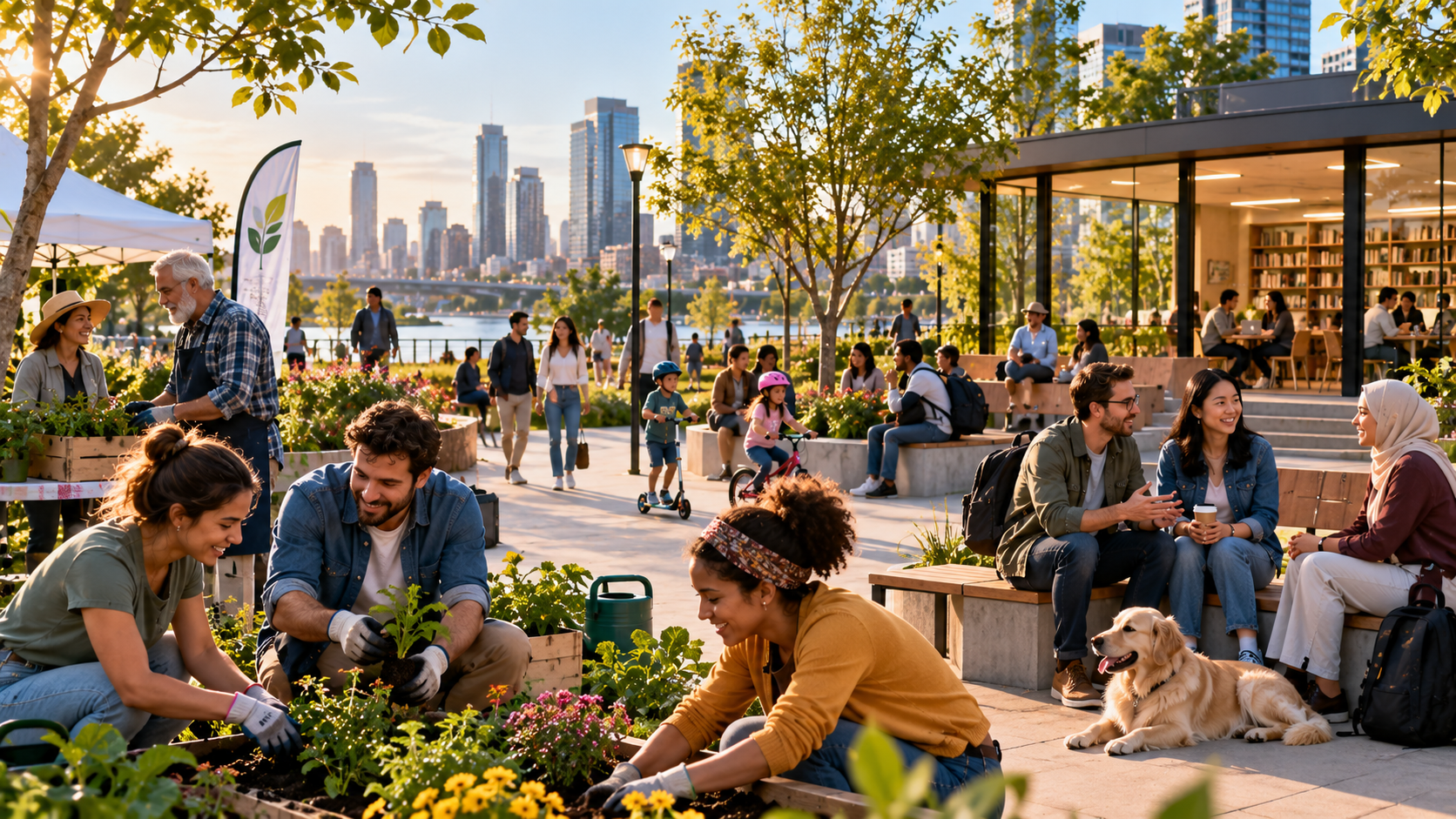
The physical environment plays a major role in determining whether those relationships have an opportunity to develop. Parks, libraries, community centres, pedestrian streets, markets, playgrounds and other public places create settings where different groups can share the same environment.
UN-Habitat’s recent work emphasises that well-designed public spaces can support physical and mental health, social cohesion and community engagement. Its research also treats public space as more than an urban design issue: these places can support local economies, inclusion and everyday interaction.
This matters because communities cannot be built entirely through formal meetings. Sometimes connection begins with something much less organised: people sitting in the same park, children playing in a shared space, neighbours attending a local event or residents encountering one another while walking through a lively public area.
A successful community space does not force people to interact. It simply makes interaction possible.
Volunteering Turns Connection Into Participation
Belonging becomes stronger when people have opportunities to contribute. Volunteering is one of the clearest examples because it transforms passive membership into practical participation.
According to the OECD, just under one-quarter of the population across OECD countries formally volunteers at least once a month. The organisation describes volunteering as a contributor to local development, social cohesion and community resilience, while also noting that participation has come under pressure in many places.
The value of volunteering goes beyond the immediate task. Someone helping at a community event, supporting a local organisation or contributing skills to a neighbourhood project is also building relationships and learning how the community functions.
That creates a useful cycle. People become more familiar with one another, trust can grow through repeated cooperation and local problems become easier to address collectively.
Digital Communities Are Changing the Meaning of Local
The internet has not simply weakened community life. It has also created new ways for people to organise it.
Local groups can now communicate instantly, share information about neighbourhood issues, coordinate volunteers and reach people who might never attend a traditional community meeting. Digital platforms can also connect people around interests that may not have a physical organisation nearby.
The most effective communities increasingly combine both worlds. A digital group can help people discover an event, organise transport or coordinate a project, while the actual relationship develops through face-to-face participation.
This hybrid model is becoming particularly important as social life becomes more distributed. The online environment can provide the coordination layer, while physical places provide opportunities for deeper interaction.
Inclusion Determines Who Gets to Belong
A community is not necessarily strong simply because many people participate in it. The more important question is who has the opportunity to participate.
Public spaces, community organisations and local activities can unintentionally exclude people through poor accessibility, cost, location, limited opening hours or a lack of attention to different needs. When that happens, community life becomes concentrated among people who already have time, resources and confidence to take part.
UN-Habitat’s 2025 research on spatial inclusion places participation at the centre of efforts to create more inclusive cities. It highlights access, proximity and connectivity to housing, services and opportunities as important dimensions of whether people can fully participate in urban life.
This principle applies far beyond cities. A healthy community needs multiple ways to participate. Not everyone can attend a meeting in the evening, volunteer every weekend or travel across a large area. Flexible forms of involvement can make community life accessible to a much wider range of people.
Younger and Older Generations Need Each Other
Community connections can also bridge generational divides. In many societies, younger and older people increasingly live, work and socialise in different environments. Community institutions can create opportunities for those groups to interact naturally rather than remaining separated by age.
This can benefit both sides. Younger people may gain experience, mentoring and a stronger connection to local history, while older residents can gain access to new technologies, activities and social networks.
The result is more than intergenerational contact. Communities become places where knowledge and skills circulate rather than disappear into separate social circles.
Local Action Can Solve Problems That Large Systems Cannot
National governments and large institutions have an important role in addressing social challenges, but many everyday problems are experienced locally. A neglected public space, an isolated group of residents, a lack of activities for young people or difficulty accessing local services may require solutions that are specific to one community.
Local participation can reveal details that larger institutions might miss. Residents know how a neighbourhood actually functions because they experience its strengths and weaknesses every day.
This does not mean communities should be expected to solve structural problems on their own. Instead, local knowledge can make broader policies more effective. When residents, organisations and public authorities work together, decisions can reflect real conditions rather than assumptions made from a distance.
The Economic Value of Community Is Often Overlooked
Community also has an economic dimension. Local markets, independent businesses, cultural events and community organisations can create activity that keeps money and opportunity circulating within an area.
Volunteering itself has measurable economic significance. OECD research estimates that the economic value of volunteering represents around 1.9 percent of GDP across OECD countries, illustrating that unpaid community activity can make a substantial contribution to society.
But the economic value of community is not limited to figures. A neighbourhood where people know one another, public spaces are used and local organisations are active can become more attractive for residents and businesses alike.
Social trust is difficult to measure, but it can influence whether people are willing to cooperate, share resources and invest time in local initiatives.
Building Communities Takes More Than Bringing People Together
The strongest communities are rarely created by a single project. They develop through repetition.
A park has to remain usable. A community centre needs regular activities. A volunteer organisation needs continuity. A local digital group needs people willing to maintain it. Trust grows when people repeatedly see that participation leads to something real.
That makes community building a long-term process rather than a one-time campaign. UN-Habitat’s work on public spaces similarly stresses ongoing management, accessibility and community participation rather than focusing only on physical construction.
The goal is not to recreate an idealised version of neighbourhood life from the past. Communities today can be more diverse, more mobile and more digitally connected than previous generations. Their strength can come from combining those characteristics rather than resisting them.
A Stronger Future May Start Close to Home
The idea of community can sound old-fashioned in a world defined by global networks, remote work and instant communication. In practice, those changes may make local connection more valuable rather than less.
People still need places where they can meet, contribute and be recognised. They still benefit from relationships that exist beyond screens. And when societies face disruption, the ability to cooperate at a local level can become an important source of resilience.
The future of community will probably not be built around one particular institution or technology. It will emerge from the combination of physical places, digital networks, local organisations and ordinary people willing to participate. The strongest communities are not necessarily the largest ones. They are the ones that give people a genuine reason to feel that they belong.