
A community is often easiest to notice when something goes wrong. A severe storm cuts electricity, a local business closes, a neighbourhood faces an unexpected disruption or a public service suddenly becomes unavailable. In those moments, formal institutions matter enormously, but so do the informal relationships between people who live, work and participate in the same place.
Resilience is often described in terms of infrastructure, emergency planning or economic strength. Yet there is another layer that is harder to measure but equally important: the ability of people to cooperate. Communities with stronger social connections can share information, organise assistance and respond collectively when normal systems are under pressure.
That does not mean every community is naturally resilient. Trust has to be built, participation has to be possible and local institutions need enough capacity to turn cooperation into practical action.
The Social Side of Resilience
Resilience is not simply the ability to recover after a crisis. It is also the ability to adapt while circumstances are changing.
This distinction is becoming increasingly important as communities face overlapping pressures. Economic uncertainty, demographic change, climate-related risks, migration and rapid technological shifts can alter local life without producing one clearly defined crisis. A neighbourhood may need to adapt gradually rather than rebuild after a single dramatic event.
Research from the OECD increasingly treats social capital as an important part of this process. Its 2026 work defines social capital through elements such as shared values, social connections, civic engagement and institutional arrangements that encourage cooperation, linking these factors with well-being, economic performance and resilience.
In practical terms, this means that relationships are a form of community infrastructure. They may not appear on a map, but they can determine how quickly people communicate, whether residents are willing to help one another and how effectively local organisations can mobilise.
Trust Is Becoming a Scarce Resource
Strong communities cannot function without some degree of trust. People have to believe that cooperation is worthwhile and that others will contribute rather than simply benefit from the efforts of everyone else.
Yet trust is under pressure in many societies. The United Nations’ World Social Report 2025 identified declining social trust, inequality, economic insecurity and social fragmentation as interconnected threats to social cohesion. The report also found that less than 30 percent of people globally believe that most people can be trusted.
This matters at the local level because distrust can make even relatively simple problems harder to solve. Residents may be less willing to participate in neighbourhood initiatives, organisations may struggle to recruit volunteers and public institutions may find it more difficult to persuade people that collective decisions are legitimate.
Trust does not usually return because someone announces that it should. It develops through repeated experiences in which cooperation produces visible results.
Small Projects Can Create Larger Connections
One of the most effective ways to strengthen local relationships is to give people something practical to work on together.
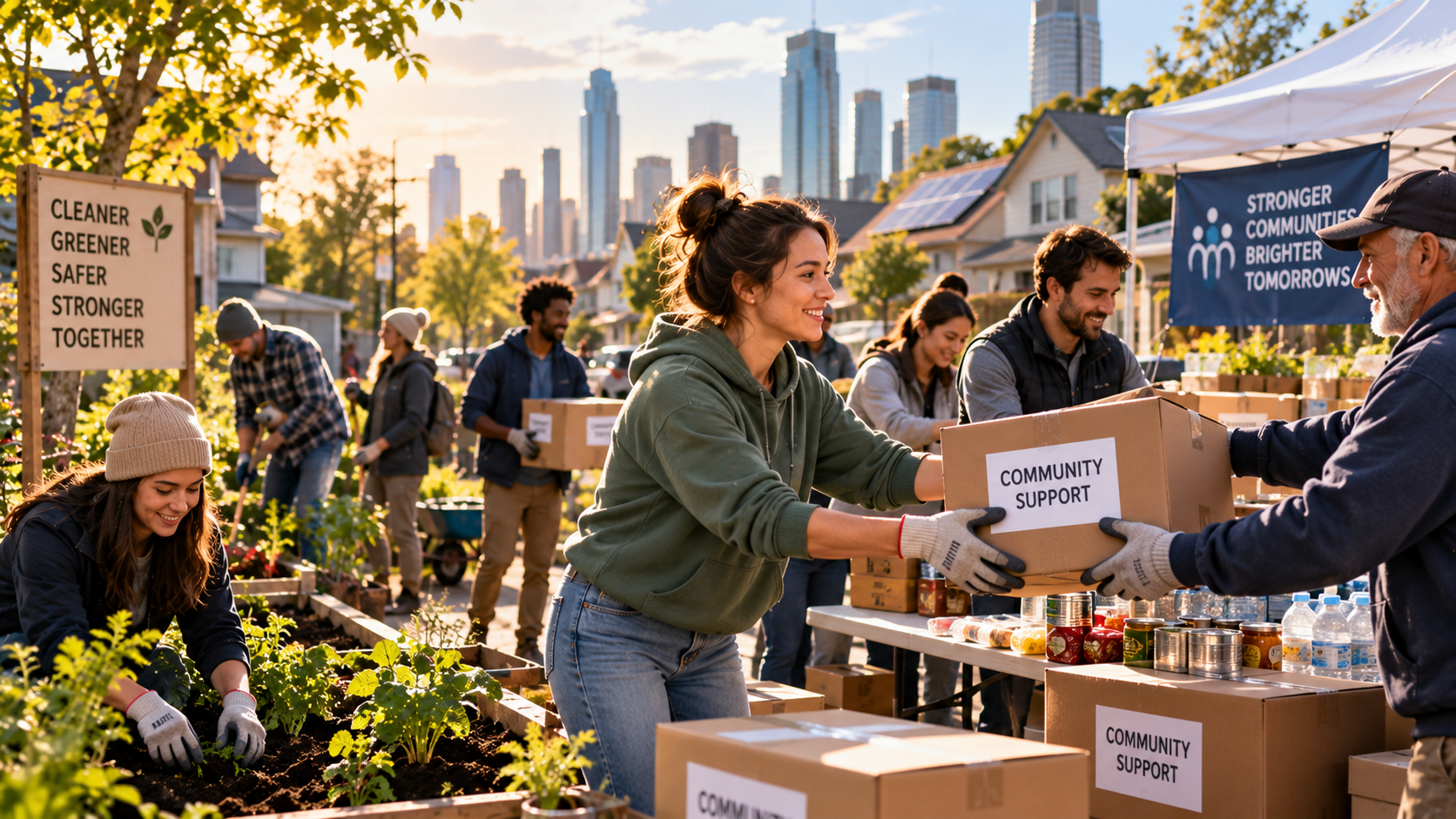
A community garden, neighbourhood renovation, cultural event, local sports programme or volunteer project may appear modest compared with national development programmes. But these activities can create repeated contact between people who otherwise might never meet.
The OECD’s research on volunteering shows that just under one-quarter of people across OECD countries formally volunteer at least once a month. It also highlights the contribution of volunteering to local development, social cohesion and resilience during societal pressures and shocks.
The important element is not the scale of the project. It is the opportunity to move from being a resident or observer to becoming a participant.
Once people have worked together successfully, the next collective effort becomes easier. Familiarity reduces hesitation, informal networks develop and practical knowledge accumulates.
Public Spaces Can Become Community Infrastructure
The physical design of a place can either support those connections or make them harder to develop.
A park, library, community centre, market, square or pedestrian area provides somewhere for people to encounter one another. These spaces become especially valuable when they are accessible to different age groups, income levels and social backgrounds.
UN-Habitat’s recent work describes public spaces as important platforms for social interaction, civic engagement, recreation and community participation. Its Global Public Space Programme also links well-designed public spaces with social inclusion, local economies and resilience.
The idea of public space is changing as well. A new OECD paper published in 2026 examines what it calls adaptive communal spaces: places shaped and managed collectively by local communities to respond to changing needs. Community gardens, cultural hubs and shared spaces for local economic activity can become part of a more flexible model of neighbourhood development.
The significance of this approach is that communities are not simply users of public space. They can also become participants in deciding how those spaces function.
Local Knowledge Matters During Disruption
When a crisis occurs, official information can tell people what is happening, but local knowledge often determines what happens next.
Residents know which roads regularly flood, which neighbours may need assistance, which buildings are difficult to access and which communication channels actually reach people. Local organisations may already have relationships that would take outside agencies months to establish.
This is one reason community participation is increasingly connected to resilience planning. UN-Habitat’s work on spatial inclusion emphasises access, proximity, connectivity and participation as important elements of inclusive communities.
The lesson is not that local communities should replace professional emergency services or public institutions. Rather, resilience improves when formal systems can work with the knowledge and networks that already exist locally.
Digital Networks Can Strengthen Physical Communities
Community resilience no longer depends entirely on physical proximity. Digital communication has created another layer of local organisation.
Neighbourhood groups can distribute information quickly, coordinate volunteers, share updates about services and connect people with resources. During disruptions, these networks can sometimes function as an informal information system operating alongside official channels.
But digital networks also have weaknesses. Online communities can fragment into separate groups, amplify rumours or become dominated by the most active participants. Technology can connect people, but it does not automatically create trust.
The strongest model is often a combination of digital coordination and physical participation. A message can organise a meeting, a volunteer shift or a neighbourhood response, but the deeper social relationship is usually created through repeated interaction.
Inclusion Determines the Strength of the Whole
A community cannot be considered resilient if large groups of people are systematically excluded from participation.
Older residents, people with disabilities, migrants, low-income households, young people and others facing barriers may have different needs and different levels of access to local institutions. If community initiatives are designed around only the most visible or well-connected residents, resilience becomes uneven.
UN-Habitat’s 2025 research on spatial inclusion stresses the importance of access to services, opportunities and housing, with participation at the centre of efforts to reduce spatial inequality.
Inclusion therefore has a practical function. The wider the range of people able to participate, the more knowledge, skills and experience a community can draw on when conditions change.
Economic Resilience Starts Locally Too
Community resilience is not limited to social relationships. Local economic networks can determine how well an area absorbs disruption.
Independent businesses, local services, social enterprises, markets and community organisations can provide employment and keep resources circulating within an area. When local economic relationships are diverse, a community may have more ways to adapt when one sector experiences difficulties.
This does not mean local economies should operate independently from national or international markets. Modern communities are deeply connected to wider economic systems. The goal is greater flexibility, so that local activity does not collapse whenever one external condition changes.
Community-led economic initiatives can also address social problems at the same time. A local enterprise may create employment, provide a service and bring people together around a shared objective.
The Future of Community Will Be More Participatory
The traditional image of community often focuses on a fixed neighbourhood and long-established institutions. Modern communities are more complicated.
People move more frequently, work remotely, maintain relationships across borders and participate in several social networks at once. A person can belong simultaneously to a residential community, a professional network, a cultural group and an online community.
This does not make local communities irrelevant. It changes what they need to offer.
The strongest communities may increasingly be those that allow people to participate in different ways rather than demanding a single form of involvement. Some residents will volunteer regularly. Others may contribute specialist skills, attend occasional events, help during emergencies or participate in local decision-making.
What matters is the existence of meaningful pathways into collective life.
Resilience Is Built Before the Crisis
The most important lesson about community resilience is also the simplest: relationships cannot be created instantly when they are suddenly needed.
A community that has spent years developing trust, maintaining public spaces, supporting local organisations and encouraging participation has more resources to draw on when conditions become difficult. The response to a crisis begins long before the crisis itself.
That makes community building a form of long-term preparation. It is not only about creating pleasant neighbourhoods or organising social activities. It is about developing the relationships, institutions and shared spaces that allow people to act together.
In a world facing faster economic, environmental and social change, resilience will increasingly depend on this ability to cooperate. Technology can improve communication and governments can provide essential infrastructure, but neither can fully replace the human networks that make collective action possible.
The communities best prepared for the future will not necessarily be those that experience the fewest disruptions. They will be those capable of adapting together when disruption arrives.