
Cultural heritage is often imagined as something preserved behind glass: an ancient building, a historic object, a manuscript or an archaeological site protected from the passage of time. But some of the most important parts of human heritage cannot be placed in a museum. They exist in the way people speak, cook, celebrate, make things, perform music, tell stories and pass knowledge from one generation to the next.
This is living heritage. It includes traditions that remain part of everyday life rather than becoming objects of historical observation. UNESCO’s 2003 Convention describes intangible cultural heritage as practices, knowledge, skills and expressions recognized by communities as part of their heritage. Crucially, it also recognizes that these traditions are constantly recreated as communities respond to their environment, history and changing circumstances.
That distinction matters. A tradition does not necessarily disappear when it changes. In many cases, change is precisely what allows it to survive.
Tradition Is Not a Frozen Picture of the Past
Every generation inherits cultural practices, but it rarely reproduces them in exactly the same way. Language evolves, musical styles absorb new influences, recipes change as ingredients become available, crafts respond to new markets, and celebrations adapt to different social conditions.
This does not automatically weaken cultural identity. UNESCO’s approach to intangible heritage explicitly recognizes transmission as a creative process. Practices evolve as they move from person to person and from generation to generation, while their continued viability depends on knowledge and skills remaining meaningful to those who practise them.
This makes living heritage fundamentally different from an artefact. A historical object can remain physically unchanged for centuries, while a living tradition depends on people continuing to use it. Its survival therefore depends less on freezing a particular version in time and more on maintaining the conditions in which people can continue to practise it.
The distinction is increasingly important in a rapidly changing world. Communities are moving, working differently, communicating through digital platforms and encountering cultural influences that were once separated by geography. Heritage now has to exist within a much more connected social environment.
The Knowledge That Lives Between Generations
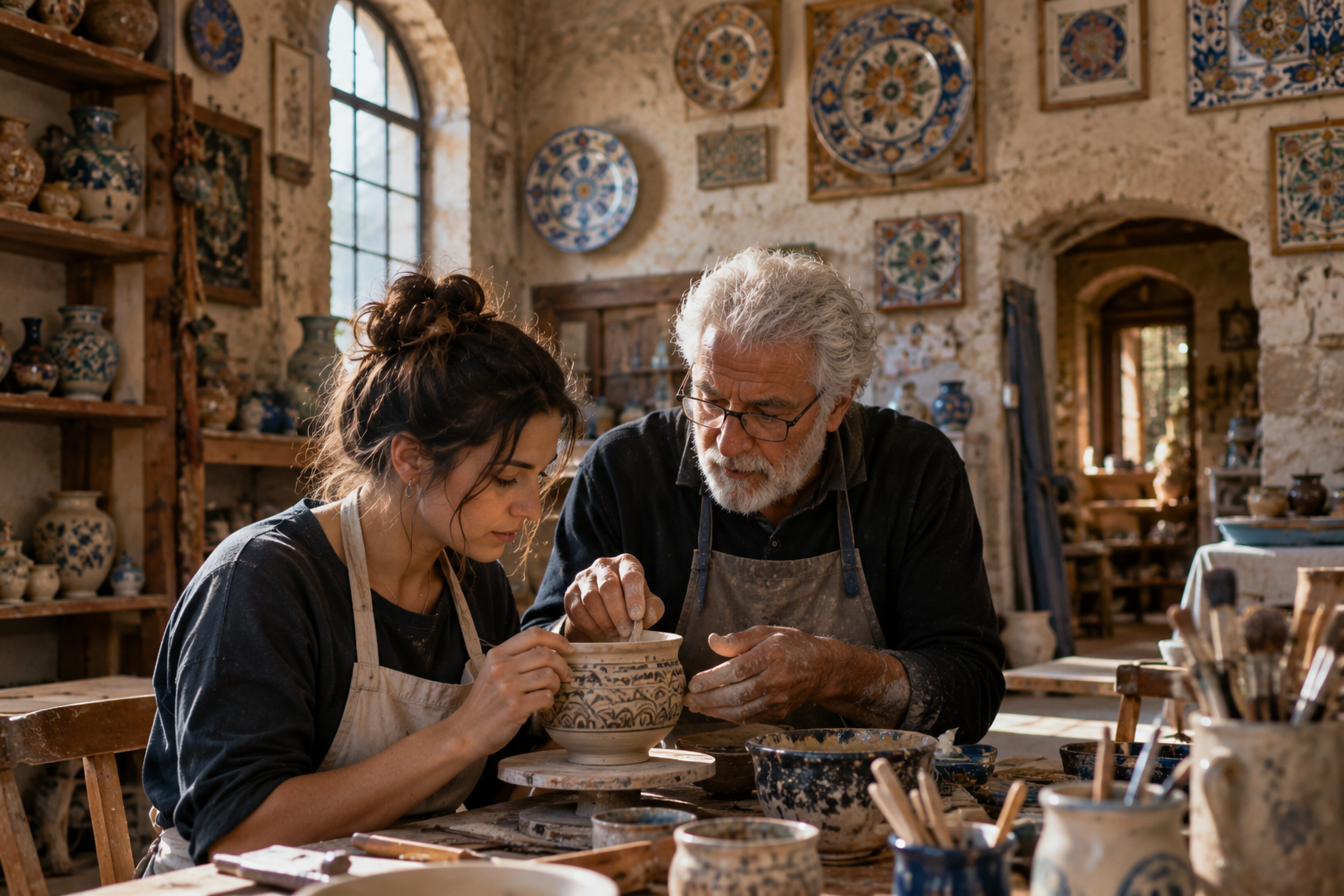
One of the strongest protections for cultural traditions is still remarkably simple: one person teaching another.
A craftsperson showing an apprentice how to work with a material, an older relative teaching a family recipe, musicians passing on a performance technique or a community sharing knowledge about local landscapes are all forms of cultural transmission. They preserve information that may be difficult to capture completely in books or databases because the knowledge often includes gestures, timing, judgement and experience.
UNESCO places intergenerational transmission at the centre of safeguarding intangible cultural heritage and describes it as a form of informal education that has long taken place within communities. Formal and non-formal education can strengthen this process by creating additional spaces for young people to encounter and practise living heritage.
This does not mean turning every tradition into a school subject. In many cases, the most effective learning remains practical and social. Young people need opportunities to participate rather than simply read about a cultural practice.
That difference can determine whether a tradition remains relevant. Knowing that a craft once existed is historical knowledge. Knowing how to make it, understanding why it matters and having a reason to continue using it keeps the tradition alive.
Young People Are Changing the Way Heritage Is Transmitted
The relationship between younger generations and tradition is sometimes described as a conflict between old and new. In reality, the process is often more complicated.
Young people may encounter traditional knowledge through family members, schools, community organisations or cultural events, but they can also transmit it through entirely different channels. Social media, video platforms, digital archives and online communities allow cultural expressions to travel beyond their original geographic boundaries.
A traditional performance can be recorded and shared with an audience thousands of kilometres away. A craft technique can be demonstrated through a short video. A language community can use digital communication to keep vocabulary and expressions in everyday circulation. A recipe can move from a family kitchen to a global audience without losing its connection to the people who created it.
Digital technology does not automatically protect living heritage, however. Recording a tradition is not the same as sustaining it. A video can document how something is done, but it cannot by itself replace the relationships, skills and community participation that give the practice its meaning.
The strongest digital projects therefore work as bridges rather than substitutes. They can help people discover heritage, connect practitioners with learners and create new opportunities for transmission while leaving the practice itself in the hands of the communities that carry it.
Migration Can Change Heritage Without Erasing It
Movement across borders is another powerful force reshaping living heritage.
When people migrate, they rarely leave their cultural practices completely behind. Languages, foods, music, religious or social traditions, crafts and celebrations can travel with communities and develop new forms in different environments. A tradition may acquire new ingredients, new vocabulary, new performance spaces or new audiences while still retaining connections to its origins.
This process can create cultural identities that are more layered than traditional ideas of geographical heritage suggest. A practice may belong simultaneously to a place of origin, a diaspora community and a new generation that has grown up somewhere else.
For heritage preservation, this means that cultural continuity should not always be measured by whether a tradition remains unchanged in its original location. Sometimes survival depends on its ability to travel.
Digital communication has accelerated that process. Communities separated by distance can remain connected, exchange knowledge and participate in shared cultural activities. What once depended almost entirely on physical proximity can now exist across a much wider social network.
When Heritage Becomes Part of the Economy
Living heritage also has an economic dimension. Traditional crafts, food production, cultural events and other heritage-related activities can provide income and support livelihoods. UNESCO notes that economic activity connected with living heritage can help sustain both communities and the transmission of cultural practices.
But commercial success can create a difficult balance.
When a traditional product becomes popular, demand can provide new opportunities for practitioners. At the same time, pressure to produce faster, cheaper or in larger quantities can change the practice itself. Tourism can create income while also encouraging simplified versions of traditions designed primarily for visitors.
The question, therefore, is not whether living heritage should participate in the modern economy. It already does. The more important question is who controls that participation and who benefits from it.
UNESCO’s current guidance emphasizes a rights-based and community-centred approach to the economic dimensions of intangible heritage, recognizing both the opportunities and the risks associated with commercialization.
When practitioners and communities have a meaningful role in deciding how their heritage is represented and used, economic activity can strengthen transmission instead of replacing it.
Climate Change Is Rewriting Cultural Traditions Too
Environmental change is becoming another major challenge for living heritage.
Many cultural practices are closely connected to landscapes, seasons, plants, animals, water and local ecological knowledge. When those environments change, the traditions associated with them can also be affected.
A changing climate can disrupt agricultural calendars, alter access to traditional materials, affect food practices and force communities to adapt long-established ways of interacting with their surroundings. UNESCO now explicitly addresses the relationship between climate action and living heritage, noting that intangible heritage can contribute to resilience, preparedness and adaptation while itself being placed under pressure by climate change.
This creates an important shift in how heritage can be understood. Traditional knowledge is not simply something inherited from the past; in some communities it can also contain practical knowledge about managing natural resources, adapting to local conditions and responding to environmental uncertainty.
Safeguarding such knowledge can therefore have consequences beyond cultural preservation. It can contribute to environmental resilience while helping communities maintain a sense of continuity during periods of rapid change.
Preservation Works Best When Communities Lead
Perhaps the most important principle in protecting living heritage is that the people who practise it cannot be treated as secondary to the preservation process.
A tradition may be photographed, catalogued, recorded and placed on a heritage register, but these activities do not guarantee that it will remain part of community life. Safeguarding becomes meaningful when practitioners, families, cultural organisations and local communities have the opportunity to decide how their heritage is transmitted and represented.
UNESCO’s Convention places respect for the communities, groups and individuals concerned among its central purposes. Its approach also recognizes participation as an important part of safeguarding.
That principle is especially important when heritage becomes visible to global audiences. The wider the audience, the greater the need to consider consent, cultural ownership, context and the right of communities to determine how their traditions are shared.
The goal should not be to turn living cultures into permanent performances of the past. It should be to give communities the freedom and resources to keep their cultural practices meaningful in the present.
A Tradition Survives Because Someone Still Uses It
The future of cultural heritage will not be decided only by what museums preserve or archives digitize. It will also be determined in homes, classrooms, workshops, community spaces, festivals and increasingly on digital platforms.
Living heritage survives when knowledge continues to move between people. It survives when young generations see value in learning it, when practitioners can make a sustainable living from it, when communities have control over its representation and when traditions are allowed to respond to new social and environmental realities.
UNESCO’s work increasingly connects living heritage with education, sustainable development, livelihoods, climate resilience and community participation, reflecting a broader understanding of heritage as part of contemporary life rather than a separate category of the past.
That may be the most useful way to think about cultural continuity today. A tradition does not remain alive because it never changes. It remains alive because people continue to find reasons to carry it forward.
The past reaches the future not as an exact copy, but as knowledge that each generation has the opportunity to reinterpret, practise and pass on.