
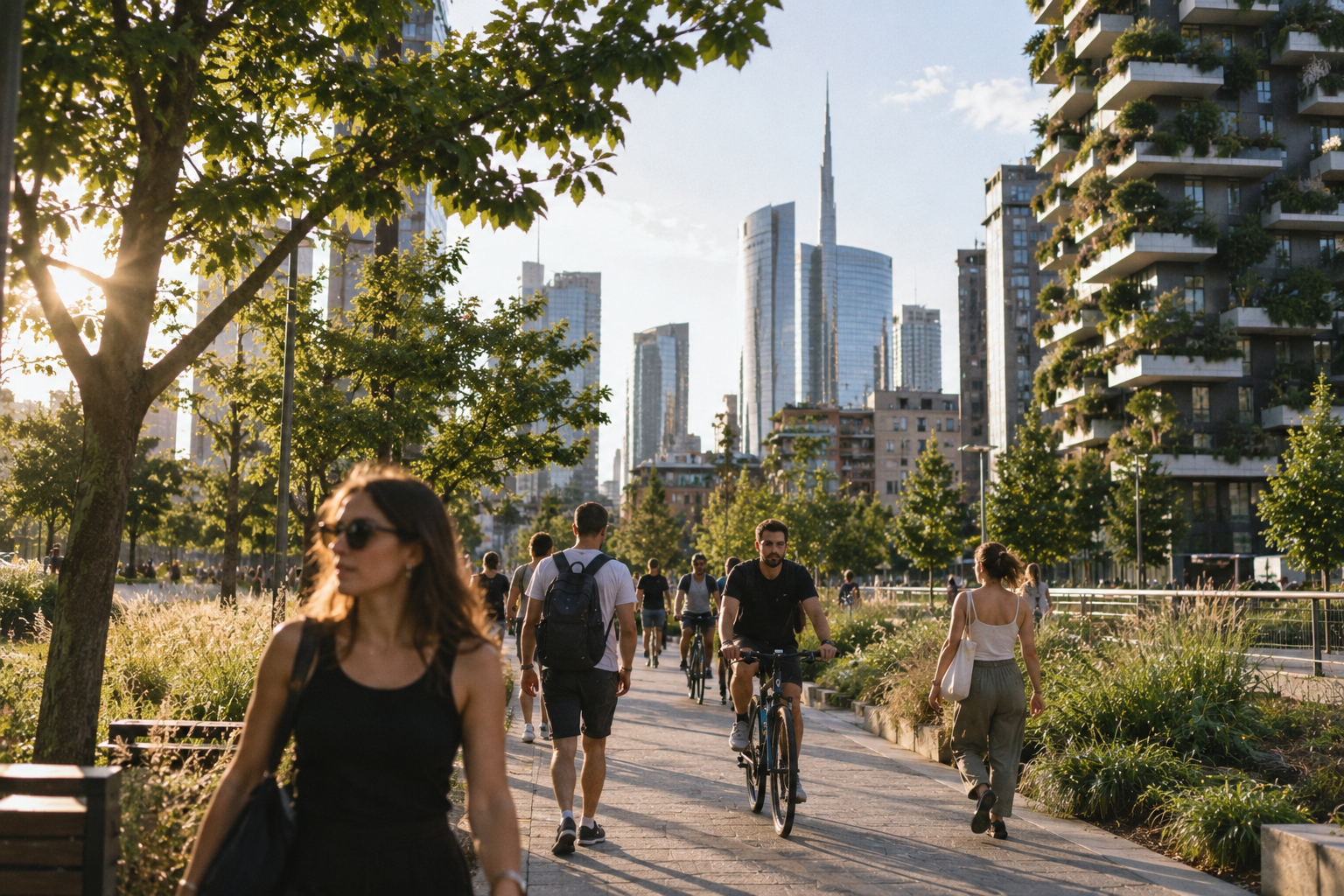
Cities have always been places of adaptation. They expand as populations grow, redesign transport networks when mobility patterns change and replace old infrastructure when technology creates new possibilities. But the environmental pressures facing urban areas today are forcing a different kind of transformation.
Higher temperatures, heavier rainfall, prolonged droughts, air pollution and rising pressure on natural resources are changing the conditions under which cities operate. Infrastructure designed for the climate of the past may no longer be sufficient for the conditions of the future.
The challenge is not simply to make cities greener. It is to make them capable of functioning reliably in a more unpredictable environment.
That means changing buildings, streets, drainage systems, public spaces, transport networks and even the way urban planners think about nature.
Cities Are Experiencing a New Climate Reality
Urban areas are particularly exposed to environmental change because large numbers of people and economic activities are concentrated within relatively small spaces.
A heatwave that affects an entire metropolitan area can put pressure on electricity networks as demand for cooling rises. Heavy rainfall can overwhelm drainage systems, disrupt transport and damage buildings. Extended dry periods can put pressure on water supplies and urban vegetation.
The physical structure of cities can make these effects stronger.
Concrete, asphalt and buildings absorb and retain heat, creating what is known as the urban heat island effect. Temperatures can remain significantly higher in densely built areas than in nearby rural surroundings, particularly at night when urban surfaces slowly release the heat they have accumulated during the day.
This makes urban design an increasingly important part of climate adaptation.
Trees Are Becoming Urban Infrastructure
For decades, trees and parks were often treated primarily as amenities that made cities more attractive. That perception is changing.
Urban vegetation can provide shade, reduce surface temperatures, absorb some rainfall and improve the quality of public spaces. Trees can also contribute to biodiversity and create habitats for birds, insects and other species.
The European Environment Agency has identified green and blue urban spaces as important tools for reducing the effects of heat and improving climate resilience in cities. Parks, trees, waterways and other forms of urban nature can provide cooling and help manage stormwater while also supporting health and well-being.
This changes the way planners calculate the value of green space. A park is no longer simply an attractive feature. It can also perform practical environmental functions.
The idea is sometimes described as green infrastructure because natural systems are being treated as part of the infrastructure required to keep cities functioning.
The Battle Against Urban Heat
Heat is likely to become one of the most important environmental challenges for cities.
The World Health Organization identifies extreme heat as a growing health risk, particularly for older people, people with chronic conditions, outdoor workers and other vulnerable groups. Urban environments can intensify exposure because buildings and paved surfaces retain heat.
Urban adaptation can therefore involve surprisingly basic interventions.
More trees can create shade. Lighter and more reflective surfaces can reduce heat absorption. Buildings can be designed for better ventilation and insulation. Public spaces can provide areas where people can escape direct sunlight.
Cities can also use technology to understand where heat is concentrated. Satellite imagery, sensors and detailed urban climate models allow planners to identify neighbourhoods that experience the greatest exposure.
The result is a shift from treating heat as a city-wide problem toward understanding where and why particular communities are most vulnerable.
Rainfall Requires a Different Kind of Infrastructure
Climate adaptation is not only about keeping cities cool. In many places, increasingly intense rainfall creates another challenge.
Traditional drainage systems were designed around historical rainfall patterns. When unusually heavy precipitation arrives within a short period, pipes, channels and pumping systems can become overwhelmed.
This has encouraged cities to rethink how they manage rainwater.
Instead of trying to move every drop away as quickly as possible, planners are increasingly looking for ways to slow, absorb and temporarily store water. Rain gardens, permeable surfaces, wetlands, green roofs and restored waterways can all help reduce pressure on conventional drainage infrastructure.
The European Environment Agency describes nature-based solutions as an important part of urban adaptation because they can reduce climate risks while providing additional environmental and social benefits.
This represents a fundamental change in thinking. Water is no longer automatically treated as something that must be removed from the city. In some circumstances, it can be managed as a resource.
Buildings Will Have to Work Harder
Buildings are responsible for a substantial share of energy use and are directly exposed to changing temperatures.
Older structures may have been designed around climatic conditions that are becoming less common. Poor insulation can increase heating and cooling requirements, while inadequate ventilation can make indoor spaces dangerously hot during extreme weather.
Future construction therefore has to consider resilience as well as energy efficiency.
Passive cooling, better insulation, shaded windows, efficient ventilation and materials that respond appropriately to local climate conditions can reduce the amount of energy needed to maintain comfortable indoor temperatures.
The European Commission’s work on the energy performance of buildings increasingly connects renovation with climate resilience, recognising that buildings need to cope with both energy and environmental challenges.
The biggest challenge may not be constructing new buildings, however. Most buildings that will exist in the coming decades have already been built.
Retrofitting existing housing and commercial structures will therefore become an increasingly important part of urban adaptation.
Transport Is Part of the Environmental Equation
Urban transport affects both emissions and the physical environment.
Cities that depend heavily on private vehicles require extensive road networks, parking areas and fuel infrastructure. These systems consume space that could otherwise support housing, public transport, trees or pedestrian areas.
The transition toward cleaner urban mobility is therefore about more than replacing petrol and diesel vehicles with electric ones.
Walking, cycling and public transport can reduce congestion, lower emissions and make better use of limited urban space. Well-designed transport systems can also make communities more resilient by giving people alternatives when one mode of travel is disrupted.
Electric vehicles will remain an important part of transport decarbonisation, but electrification alone cannot solve every urban problem. The amount of space dedicated to movement, the distance between homes and services and the quality of public transport all influence how environmentally sustainable a city can become.
Nature Can Become Part of the City Again
For much of modern urban development, nature was treated as something that had to be controlled.
Rivers were channelled, wetlands were drained and open land was converted into buildings and roads. In many places, this made cities easier to develop but also removed natural systems that once absorbed water, reduced heat and supported biodiversity.
The emerging approach is different.
Urban planners are increasingly looking for ways to restore natural functions without removing cities themselves. Rivers can be given more space, wetlands can be protected or recreated, and biodiversity corridors can connect fragmented green areas.
The concept of reintroducing natural processes into urban environments is becoming part of a broader movement toward nature-based solutions. The United Nations Environment Programme has highlighted the potential of ecosystem-based approaches to strengthen climate resilience while delivering benefits for biodiversity and human well-being.
The goal is not to turn cities into forests. It is to recognise that urban systems and natural systems can function together.
Climate Adaptation Is Also a Question of Inequality
Environmental risks are rarely distributed evenly across a city.
Wealthier neighbourhoods may have more trees, better-maintained buildings and easier access to cooling. Lower-income communities may live in areas with fewer green spaces, older housing or greater exposure to heat and flooding.
This creates an important social dimension to urban adaptation.
A city can technically become more resilient while leaving its most vulnerable residents behind. If a new park raises housing costs and pushes lower-income residents elsewhere, for example, the environmental improvement may produce an unintended social consequence.
Successful adaptation therefore needs to consider who benefits from investment and who remains exposed to risk.
The principle of a resilient city is ultimately about people, not simply infrastructure.
Digital Tools Are Changing Urban Planning
Technology is giving cities new ways to understand environmental conditions.
Sensors can monitor air quality and temperature. Satellite imagery can track changes in vegetation and land use. Digital models can simulate flooding and heat exposure. Data from transport systems can help planners understand movement patterns and identify areas where public transport could replace private-car journeys.
Artificial intelligence can also help process large amounts of urban data, although its usefulness depends heavily on the quality of the information being analysed.
The important development is the move toward more responsive urban management. Instead of relying entirely on historical averages, cities can increasingly monitor conditions in real time and adjust services accordingly.
Technology does not eliminate environmental risk, but it can make cities more aware of how those risks are developing.
The Resilient City Will Be Designed for Change
One of the biggest challenges in urban planning is that infrastructure lasts much longer than political cycles or technology trends.
A road may remain in use for decades. A building can stand for a century. A drainage network constructed today may still be operating when environmental conditions are substantially different.
That makes long-term planning essential.
Cities need to ask not only whether a project solves today’s problem, but whether it will remain effective under future conditions. This requires planners to work with uncertainty rather than assuming that historical climate patterns will continue unchanged.
Flexibility is therefore becoming an important design principle.
Infrastructure should be capable of adapting as conditions evolve instead of locking cities into systems that become increasingly difficult and expensive to modify.
From Green Cities to Resilient Cities
The idea of the “green city” has often focused on reducing pollution, expanding parks and lowering emissions. Those goals remain important, but environmental pressures are pushing urban planning toward a broader concept: resilience.
A resilient city is one that can continue functioning when conditions become difficult. It can manage extreme heat without putting vulnerable residents at unnecessary risk. It can absorb heavy rainfall without widespread disruption. It can provide reliable transport, energy and water even when environmental conditions are changing.
That requires cooperation between environmental planning, public health, engineering, transport, housing and economic policy.
No single department can create a resilient city on its own because environmental systems do not follow administrative boundaries.
The City of the Future May Feel More Natural
The most interesting urban transformation may be a change in the relationship between built environments and nature.
For much of the industrial era, cities were designed to separate themselves from natural processes. The next generation of urban development may do the opposite.
Trees will be valued not only for their appearance but for their cooling capacity. Wetlands will be recognised as flood protection. Parks will function as social and environmental infrastructure. Buildings will be designed around local climate conditions. Streets will be planned not only for vehicles but also for pedestrians, cyclists, shade and water management.
This does not mean returning cities to a pre-industrial state. It means using natural systems intelligently alongside modern technology and infrastructure.
The cities best prepared for the future will not necessarily be those with the most advanced technology or the largest construction projects. They may be the ones that understand how to combine infrastructure, nature and human needs into a system capable of adapting to change.
As environmental pressures intensify, urban resilience is becoming less of a specialist planning concept and more of a basic requirement for modern life. The future city will not simply be cleaner. It will need to be cooler, more flexible, better connected to nature and prepared for conditions that previous generations could not always anticipate.