
Water is one of the few resources that modern society cannot replace. Energy can come from different sources, technologies can substitute for physical materials and industries can redesign production. But there is no technological alternative to the basic role that freshwater plays in human life.
For centuries, access to water was largely treated as a question of geography. Rivers, lakes, groundwater and seasonal rainfall determined where communities could grow and where agriculture could flourish. Today, that relationship is becoming more complicated. Population growth, economic development, climate change, pollution and inefficient use are placing greater pressure on freshwater systems at the same time.
The result is a new global water challenge. It is not simply about whether enough water exists on the planet. It is about where usable water is available, when it arrives, who can access it and whether natural systems can continue supplying it.
Freshwater Is Limited Despite a Water-Rich Planet
Earth may appear to have an almost unlimited supply of water, but most of it is not readily available for human use. Oceans contain the overwhelming majority of the planet’s water, while usable freshwater represents only a small fraction.
The United Nations estimates that only about 0.5 percent of Earth’s water is usable and available freshwater. At the same time, more than two billion people still lack access to safely managed drinking water, according to the 2025 UN World Water Development Report.
This creates a fundamental contradiction. The planet has enormous quantities of water, yet the freshwater required for drinking, agriculture, industry and ecosystems is geographically uneven and increasingly exposed to disruption.
That makes water management just as important as water availability.
Mountains Are the World’s Natural Water Towers
Some of the most important freshwater resources are found far from the communities that depend on them.
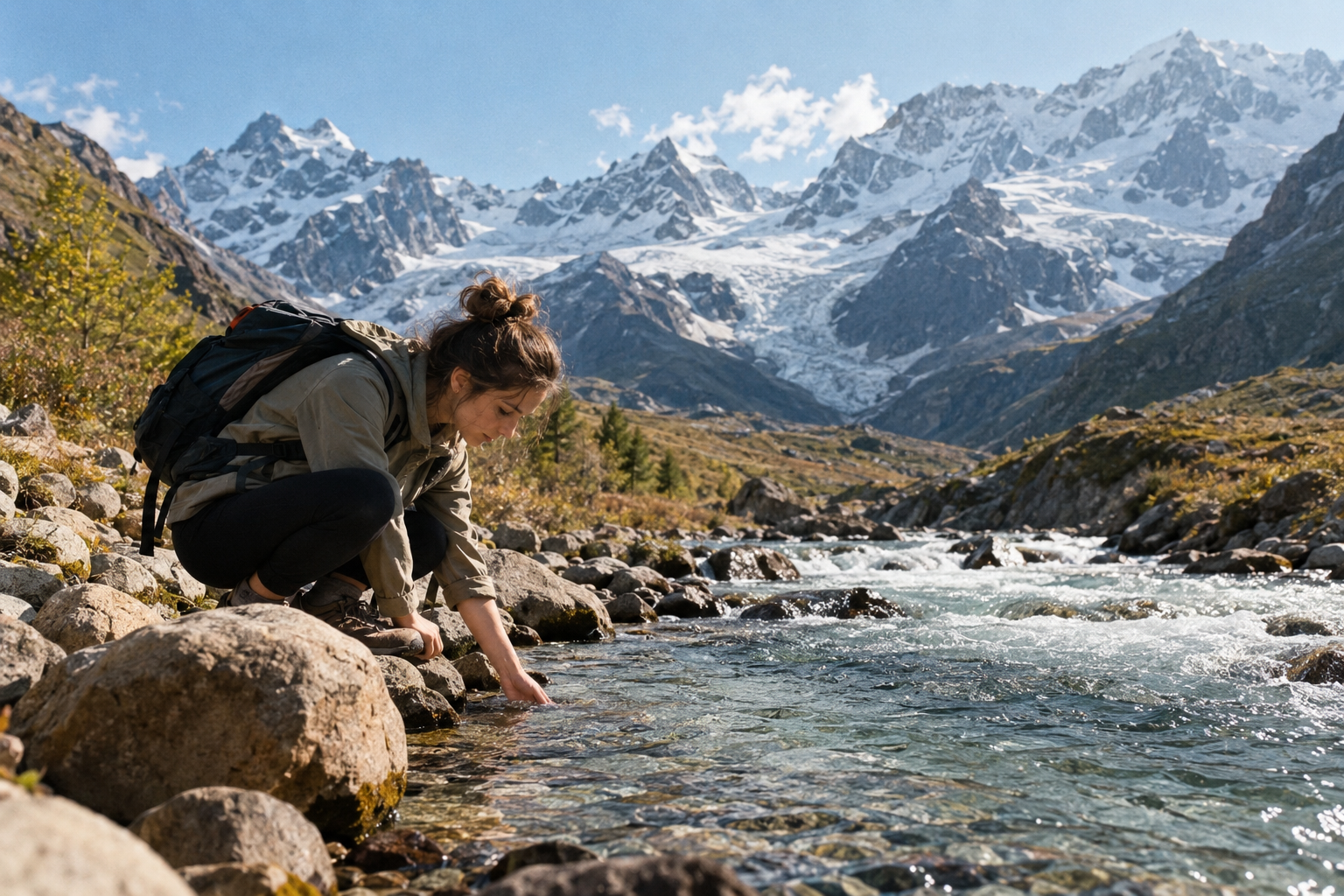
Mountain regions store water as snow and ice, gradually releasing it into rivers and watersheds. UNESCO’s 2025 World Water Development Report estimates that mountain areas provide around 55–60 percent of global annual freshwater flows, while about two billion people depend directly on mountain waters.
This makes glaciers and snowfields a form of natural infrastructure. They store water during colder periods and release it over time, helping regulate river flows that support agriculture, cities, ecosystems and energy production.
But that system is changing.
Climate change is accelerating glacier melt, reducing snow cover and altering the timing and reliability of water flows. The problem is not simply that glaciers are disappearing. Their loss can change when water becomes available, creating greater uncertainty for communities downstream.
In glacier-fed river systems, increased melting can initially raise runoff. Eventually, however, shrinking ice reserves can lead to a decline in meltwater. UNESCO describes this transition as “peak water”, after which glacier-fed runoff can decrease as the remaining ice mass becomes smaller.
Agriculture Sits at the Centre of the Water Challenge
No discussion of freshwater can avoid agriculture.
The latest UN data show that agriculture accounts for about 72 percent of global freshwater withdrawals. Industry accounts for roughly 15 percent, while services account for about 13 percent.
This makes agriculture both one of the largest users of freshwater and one of the sectors most vulnerable to changes in its availability.
Farmers need water at particular moments in the growing cycle. A shortage during planting or a critical period of crop development can have consequences that cannot easily be corrected later. Increasing temperatures can also raise evaporation, increasing irrigation requirements even where rainfall patterns remain relatively stable.
The challenge is therefore not simply to reduce agricultural water use. Food still has to be produced. The larger task is to produce more reliably with less pressure on freshwater systems.
Modern irrigation, improved soil management, better crop selection and more precise monitoring can all contribute to this transition. The UN’s 2026 Sustainable Development Goals reporting identifies agriculture as the largest opportunity for improving overall water-use efficiency.
Cities Are Entering a New Water Era
Urbanisation adds another layer to the problem.
Cities concentrate millions of people, businesses and infrastructure in relatively small areas. They require reliable water supplies not only for drinking and sanitation, but also for hospitals, schools, manufacturing, hospitality, construction and public services.
At the same time, cities are increasingly exposed to both extremes of the water cycle. Heavy rainfall can overwhelm drainage systems, while prolonged dry periods can reduce reservoirs and groundwater supplies.
Climate change makes this instability more difficult to manage. The United Nations notes that higher temperatures can intensify both heavy rainfall and dry spells by altering evaporation and atmospheric moisture patterns.
This means urban water infrastructure must become more flexible. Reservoirs and pipelines remain important, but future systems may also depend more heavily on wastewater treatment, water reuse, leakage reduction, rainwater management and real-time monitoring.
The Hidden Cost of Water Loss
One of the most important developments in water policy is a growing focus on losses rather than simply finding new supplies.
The World Bank reported in 2025 that the world is losing approximately 324 billion cubic metres of freshwater every year because of worsening droughts and unsustainable land and water management. The organisation estimated that this volume could meet the annual needs of around 280 million people.
Such figures change the way the problem is understood.
Water scarcity is not always caused by an absolute absence of water. Poor infrastructure, inefficient irrigation, deforestation, damaged wetlands, weak governance and inadequate coordination can all reduce the amount of water that remains available for productive and environmental uses.
In other words, better management can create a form of new supply without producing a single additional drop.
Technology Is Expanding the Water Toolbox
As traditional supplies become less predictable, technology is opening new possibilities.
Desalination can turn seawater into freshwater. Water reclamation can allow treated wastewater to be reused. Digital monitoring can identify leaks and track consumption. Sensors can help farmers apply irrigation more precisely, while data systems can improve decisions across entire watersheds.
The World Bank expects desalination and water reclamation to become increasingly important as water scarcity intensifies, although it also stresses that these technologies need appropriate economic, legal and regulatory frameworks.
Technology, however, is not a universal solution.
Desalination requires energy and infrastructure. Water treatment requires investment and maintenance. Digital systems depend on reliable data and skilled management. The most effective approach is therefore likely to combine technological innovation with conservation and better governance.
Groundwater Is the Resource We Cannot See
Some of the world’s most important freshwater reserves exist beneath the surface.
Groundwater supplies drinking water to communities, supports agriculture and maintains ecosystems during periods when surface water is limited. Because it is hidden, however, its decline can remain unnoticed until problems become severe.
This creates a particular management challenge. A river can be visibly low, while groundwater depletion may occur slowly over years or decades.
The long-term future of water security therefore depends on understanding both visible and invisible parts of the water cycle. Monitoring groundwater, regulating extraction and protecting the ecosystems that recharge underground reserves can be just as important as constructing new reservoirs.
Water Quality Matters as Much as Quantity
Having water available does not necessarily mean having safe water.
Pollution from agriculture, industry, sewage and other sources can make freshwater unusable or significantly more expensive to treat. Climate change can further complicate the situation. The United Nations notes that higher water temperatures and more frequent floods and droughts can worsen several forms of water pollution, including contamination from sediments, pathogens and pesticides.
This creates a double challenge. Communities must secure enough water while also protecting its quality.
Healthy rivers, wetlands, forests and soils are therefore part of water infrastructure. Natural ecosystems can filter pollutants, slow runoff, store water and support groundwater recharge. Destroying those systems can make water management more expensive and less reliable.
Water Security Is Becoming an Economic Issue
The importance of freshwater extends far beyond environmental policy.
Factories need water for production and cooling. Energy systems depend on water in various ways. Agriculture supports food markets and rural employment. Cities depend on reliable supplies for their entire service economy.
A disruption in one part of the water system can therefore spread through the wider economy.
This is why water security is increasingly being treated as a strategic issue alongside energy and food security. The three are deeply connected. Producing food requires water and energy. Producing energy can require water. Treating and moving water requires energy.
Managing one resource without considering the others can create new problems elsewhere.
A Different Approach to Water Management
The traditional approach to water often focused on building infrastructure to capture, transport and distribute supplies. That infrastructure remains essential, but the scale of today’s challenge requires a broader model.
Water systems need to be managed across entire river basins rather than through isolated projects. Agriculture, cities, industries and ecosystems all depend on the same underlying resources, even when they are governed by different institutions.
The 2025 UN World Water Development Report calls for integrated river-basin management, stronger governance, investment and greater knowledge and capacity to respond to changing mountain water systems.
This approach recognises that water does not follow administrative boundaries. A decision made upstream can affect millions of people downstream.
The Most Valuable Water May Be the Water We Protect
The future of freshwater will not be determined by one technology or one major infrastructure project. It will depend on thousands of decisions about agriculture, cities, ecosystems, industry and consumption.
Some of those decisions will involve sophisticated technologies. Others will involve repairing a leaking pipeline, protecting a wetland, improving irrigation or preventing groundwater from being overused.
The central idea is becoming increasingly clear: freshwater is not an unlimited background resource. It is a foundation on which modern economies and societies depend.
As climate change makes water flows less predictable and demand continues to grow, the most successful water strategies will be those that treat efficiency, conservation, infrastructure, technology and ecosystem protection as parts of the same system.
The world does not simply need more water. It needs to become much better at protecting, managing and sharing the freshwater it already has.